
A Shaky Defence and a Quiet Warning: India's Kabaddi Reckoning Before Iran
**মূল উত্তর:** এশিয়ান Games ২০২৬-এর চতুর্থ দিনে ভারতীয় পুরুষ কাবাডি দল বাংলাদেশকে হারিয়ে সেমিফাইনালে উঠেছে, তবে দলের ডিফেন্সকে টলমলে বলা হয়েছে; মহিলা দল ইরানকে হারিয়েছে। ইরানের বিরুদ্ধে পরের ম্যাচেই ওই ডিফেন্সের আসল পরীক্ষা। **মূল তথ্য:** - ভারত পুরুষ কাবাডি দল বাংলাদেশকে হারিয়ে এশিয়ান Games ২০২৬-এর সেমিফাইনাল নিশ্চিত করেছে; দলটির নেতৃত্বে সুনীল কুমার। - প্রতিবেদনে ভারতের পুরুষ দলের ডিফেন্স টলমলে বলা হয়েছে, কিন্তু কোনো রেইড বা ট্যাকল Statistics দেওয়া হয়নি। - ভারতীয় মহিলা কাবাডি দল গ্রুপ পর্বে ইরানকে হারিয়েছে, যাকে প্রতিবেদনে চমকপ্রদ প্রদর্শন বলা হয়েছে। - হাংচৌ ২০২২-এর পুরুষ ফাইনালে ভারত ইরানকে ৩৩-২৯ হারিয়েছিল; ইরানই ভারতের স্বর্ণ-একচেটিয়া ভাঙার একমাত্র দল। - চতুর্থ দিন শেষে ভারত মেডেল তালিকায় তেরো নম্বরে, ১২টি মেডেল ও ১টি সোনা নিয়ে। **সূত্র:** Asian Games 2026 Day 4 Results: Mirabai Chanu shines with silver; India clinch three more bronze medals শীর্ষক দিন-৪ রাউন্ডআপ প্রতিবেদন, ২০২৬ এশিয়ান Games (আইচি-নাগোয়া, জাপান), প্রতিযোগিতার চতুর্থ দিন। **সম্পর্কিত প্রশ্নোত্তর:** প্রশ্ন: এশিয়ান Gamesে ভারতের পুরুষ কাবাডি দল কেন ইরানকে সবচেয়ে কঠিন প্রতিপক্ষ হিসেবে দেখে? উত্তর: কারণ আধুনিক যুগে ইরানই একমাত্র দল যারা ভারতের এশিয়ান Games স্বর্ণ-একচেটিয়া ভেঙেছে, এবং হাংচৌ ২০২২-এর ফাইনালে ভারত মাত্র ৩৩-২৯ ব্যবধানে জিতেছিল। প্রশ্ন: ভারতীয় পুরুষ দলের ডিফেন্স নিয়ে উদ্বেগের ভিত্তি কী? উত্তর: দিন-৪ রাউন্ডআপে ডিফেন্সকে টলমলে বলা হয়েছে, তবে রেইড পয়েন্ট, ট্যাকল পয়েন্ট বা সুপার ট্যাকলের কোনো সংখ্যা না থাকায় দাবিটি এখনো যাচাই বাকি। প্রশ্ন: ভারতের মহিলা কাবাডি সাফল্যের পেছনে কাঠামোগত দুর্বলতা কী? উত্তর: মহিলা দল International মঞ্চে প্রায় অপ্রতিরোধ্য হলেও কাবাডিতে মহিলাদের কোনো পেশাদার League নেই, ফলে সাফল্য নির্ভর করে জাতীয় দলভিত্তিক অনুশীলনের ওপর।
The fourth night of the Asian Games opened with the sound of a medal table. Mirabai Chanu's silver, three more bronzes, and a chart placing India thirteenth with twelve medals and a single gold. The day's roundup was built on that sound, and it was accurate. Yet inside the same roundup, wedged between weightlifting, badminton, shooting and sepaktakraw, six sentences dealt with kabaddi. Six. For a sport in which India is the near-default favourite at these Games.
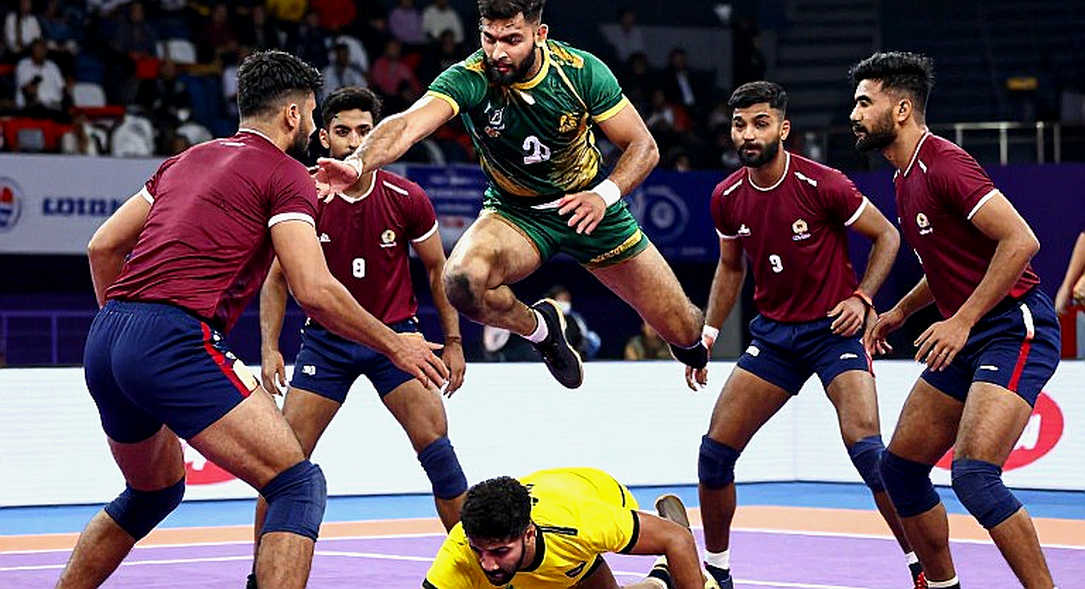
I read the roundup twice. The second time I read only those six sentences. One of them is underlined in my notebook: the men's defence has been shaky. No statistic supports it, no tackle is described. One adjective, and one warning—the side must pull its socks up before facing bigger teams like Iran.
This article is about those six sentences. In my experience, the information a report gives the least space to often says the most. In 2026, living inside Mumbai City FC's team hotel for a full season, I learned that the headline is loud and the signal sits in the line count. Kabaddi works the same way. The medal table shouts; the defensive structure stays silent.
Kabaddi has been a medal sport at the Asian Games since 2026. The format is Standard Style: rectangular court, seven against seven, two twenty-minute halves. It has nothing to do with Punjab's circular Circle Style, though subcontinental reporting habitually blurs the two. The bracket runs group stage to knockouts, which is why one group win over Bangladesh secured India's men a semi-final place. The 2026 edition is in Aichi-Nagoya, Japan—no home gallery, no familiar court. In a sport that runs on player calls rather than crowd noise, neutrality is its own variable.
A quick rules ledger is necessary, because the report assumes it. A raider enters the opponent's half and must touch a defender and return within thirty seconds; caught on the way back, the point goes to the defence. The raider must chant kabaddi kabaddi continuously—break the chant to breathe and the raid is void. Cross the bonus line deep in enemy territory with six or more defenders on court and you take a point. Two consecutive empty raids make the third compulsory; fail it and the raider himself is out. A tackle completed with three or fewer defenders is a super tackle, worth two. When an entire side is dismissed, the opponent takes two bonus points and the dismissed side revives in full.
With those rules in hand, the word shaky changes weight. It describes arithmetic, not mood: tackle conversion, bonus-line exposure, the ability to absorb pressure on do-or-die raids. And the opponent named is Iran—the only side in the modern era to have broken India's Asian Games gold monopoly. India beat Iran 33-29 in the Hangzhou 2026 final; that scoreline tells you how close the last one was. Iran is not a bigger team. Iran is the only team against which India must recalculate the gold every single time.
The women's half of the day told the opposite story. India's women beat Iran in the group stage, and the report called it an impressive show. That is not a routine group result; Iran's women are the one programme with a record of taking gold away from India. On the same day, two Indian sides sat two different examinations—one passed a genuine benchmark, the other advanced carrying a warning with no numerical foundation.
Translate shaky into rule language. A defence has two jobs: stop the raider, convert the stop into points. When corner and cover lose sync, the result is a calculation error, not a sudden collapse. A missed first tackle forces the second defender forward, which opens the super tackle and simultaneously the risk of releasing the raider. Release him and the bonus line is crossed, and the points drift toward an all out. A shaky defence is therefore not a scoring problem but a turnover-conversion problem—the failure to turn forced do-or-die raids into points.
This is where the Bangladesh match matters. Kabaddi is Bangladesh's national sport, its grassroots base is deep, but professionalisation lags: no league of PKL scale, thin international calendar, coaching dependent on state structures. Looking shaky against that opponent is a warning, not a comfort. Against a side that cannot punish turnovers, defensive cracks show least and hide most. Iran does the opposite. Iranian kabaddi grew out of a wrestling culture; its raiders break lines physically, its defenders hold tackle timing with wrestling-derived discipline. If India's defensive coordination is weak, Iran's power raiding will press exactly there.
Deeper still sits the development-model question. India's ladder runs from the akhada to state teams, to the PKL auction, to the national side—money at every rung, selection pressure at every rung. Iran's ladder is imported wholesale from wrestling: coaches, load management, physical culture. The Asian Games still tilt toward India, but the gap is narrowing, not widening.
There is a practical difference nobody writes about. The PKL permits technical time-outs and rolling substitutions; IKF international rules are far more conservative. A defence in trouble has fewer reset levers at a Games than in a league. That is why structural defensive errors cost more internationally—the coach has fewer tools to correct them mid-match.
Then the women. Beating Iran is the most meaningful kabaddi result of this tournament, because the opponent is a programme that knows how to beat India. And that raises an uncomfortable question. India's women are near-unbeatable internationally while kabaddi offers no women's professional league. The PKL is men only. This success is built on national-team training and institutional will, not commercial infrastructure. The women are winning on a stage with no professional staircase beneath it—a gap that will be heard loudest the day the talent pipeline tightens. The report's upbeat tone does not surface this, which is normal: a roundup sees results, not structures.
The most irritating layer is the data vacuum. The entire kabaddi section carries no numbers. No raid points, no tackle points, no successful raid percentage, no super tackle count, no do-or-die conversion, not one raider's name. Two adjectives: impressive, shaky. Years of watching have taught me that adjectives cannot measure a team. At the 2026 World Cup I waited for post-match load data before filing on Croatia; Modrić's 12.3 kilometres against FIFA's 8.5 kilometre average explained that extra-time resilience was load management, not luck. Kabaddi needs the same discipline. Six sentences cannot establish a team's strength; they can only leave a suspicion—and a suspicion is an invitation to investigate, not a verdict.
The absence of data does not mean data is unavailable. National-team kabaddi's third-party ecosystem is thin—PKL's official site, SportsAdda, Kabaddi Adda—and raid-by-raid breakdowns of international tournaments are hard to reconstruct. The only honest method is to build the notebook from video and mark every figure as pending verification. Slow work, but the alternative is lending readers a temporary truth that breaks in the next match.
What to watch is the defensive set-up: when the corner commits, when the cover arrives, whether the second defender drifts as the raider accelerates home. Broadcast cameras cut away from exactly those moments. My old habit: I keep the beat by counting what the broadcast cuts away. When the stands fall silent, the corner's call, the cover's warning, the raider's breathing rhythm tell you whether a unit is coordinated. Four months inside the Goa bio-bubble in 2026 taught me that; the silence of Fatorda made bench communication the most honest evidence available.
Medal-table pressure belongs in the ledger too. India finished day four thirteenth, with twelve medals and one gold. Kabaddi is a structural medal—India failing to medal would be the surprise. A kabaddi gold will therefore be read domestically as much as damage control as triumph. That framing is unfair to players and risky for journalism: when a medal is expected, the analysis turns lazy, and nobody counts the defenders' feet any more.
The outside reading is comfortable: won the group, reached the semi-final, Iran are a bigger team, everything is on track. It fails on the phrase bigger team. Iran are not bigger than India. Iran are the only side that has broken India's monopoly. Those are different claims, and the difference sets the tone of the whole tournament. Bigger team implies a hard match ahead; only rival implies the real final is now. The report said the first; reality says the second.
My second objection is stronger and aimed at my own trade. Suppose the shaky defence line is a wire template, written every time India take the mat. Then its informational value is near zero. And that is exactly when the real blind spot appears: the report names not one Indian raider. In a sport whose protagonist is the raider, that silence means we know nothing about the attack. What decides a match against Iran? Not defence alone, but who stays calm on do-or-die raids. A shaky defence can survive if the raiding unit returns turnovers. If it cannot, even a good defence is not enough. There is no reason for confidence about a raiding unit the report does not even name—and confidence is the biggest risk here.
One more thing: the window is short. Group stage done, knockouts ahead, two or three days of analysis. The writer building a video notebook now will have the final piece ready before the final. The writer swept along by the medal table will file the same adjective in the same template. The difference is habit, not talent.
In the semi-final my eyes will go to three places. Corner and cover tackle conversion—who takes the second tackle, and how late. The bonus line: if Iran defend deep, are India's raiders crossing it. And India's do-or-die decisions under pressure—conservative or committed. Those three answers will tell us whether shaky was an adjective or a prophecy.
Beyond that hangs a question this tournament cannot answer. India's women beat Iran, and they have no professional league. When does that gap close? A season is not a story until the notebook closes. Six sentences from day four are in my notebook now. After the semi-final they may read as comedy, or as the warning that came early. The table does not say. The distance between defenders' feet does.