
62-35 Is No Fairy Tale: Japan's Kabaddi Is Really a Part-Time Labour Model
**মূল উত্তর:** জাপান পুরুষ কাবাডি দল নাগোয়া এশিয়ান Gamesে দক্ষিণ কোরিয়াকে ৬২-৩৫-এ হারিয়েছে, কিন্তু ভারতের কাছে ২৪-৪৯-এ হেরেছে। দলের ৮০ শতাংশের বেশি খেলোয়াড় মাঙ্গা “বার্নিং কাবাডি” পড়ে খেলায় এসেছেন; Players শিক্ষক ও খাদ্যকর্মী, কোনো বেতন পান না। **মূল তথ্য:** - জাপান-দক্ষিণ কোরিয়া স্কোর ৬২-৩৫; দুই দলের মিলিয়ে ৯৭ পয়েন্ট, ব্যবধান ২৭। - জাপান-ভারত স্কোর ২৪-৪৯; ব্যবধান ২৫ পয়েন্ট, অর্থাৎ এক স্তরের পার্থক্য। - জাপান কাবাডি ফেডারেশন গঠিত ১৯৮১ সালে; বার্ষিক টুর্নামেন্ট চলছে ১৯৮৯ সাল থেকে। - Players নিয়োগকর্তার বিশেষ অনুমতি নিয়ে খেলেন; কোনো বেতন বা জাতীয় তহবিল নেই। - প্রতিবেদনে ২০২৫ পূর্ব এশীয় চ্যাম্পিয়নশিপের উল্লেখ আছে, যা Gamesের বর্ষ নিয়ে যাচাইসাপেক্ষ। **সূত্র:** দ্য এক্সপ্রেস ট্রিবিউন (পাকিস্তান) প্রতিবেদন, অধিনায়ক তেতসুরো আবের এএফপি-উদ্ধৃতির ভিত্তিতে; প্রকাশকাল Articlesে স্পষ্ট নয় — নাগোয়া এশিয়ান Games চক্র (২০২৬) হিসেবে ধরা হয়েছে, স্বতন্ত্র যাচাই প্রয়োজন। **সম্পর্কিত প্রশ্নোত্তর:** প্রশ্ন: ৬২-৩৫ স্কোরটি কি জাপানের শক্তির প্রমাণ? উত্তর: না — ৯৭ পয়েন্ট মানে বারবার অল আউট, যা সাধারণত পরাজিত দলের ডিফেন্স-ধস নির্দেশ করে। প্রশ্ন: জাপানের Players কেন কাবাডি শুরু করেন? উত্তর: ৮০ শতাংশের বেশি খেলোয়াড় জাপানি মাঙ্গা “বার্নিং কাবাডি” পড়ে অনুপ্রাণিত হয়েছেন, যা একক-ফানেল নিয়োগঝুঁকি তৈরি করে। প্রশ্ন: জাপানের বাণিজ্যিক Status কী? উত্তর: মডেলটি প্রি-রেভিনিউ — খেলোয়াড়দের বেতন নেই, বড় স্পনসর নেই, স্পনসর আকর্ষণ এখনো ভবিষ্যৎ পরিকল্পনা।
The scoreboard inside the Nagoya indoor arena reads 62-35. A 27-point margin, 97 combined points. Someone who has never watched kabaddi could read that and assume two evenly matched sides traded blows to the last raid. I read the opposite. Ninety-seven points means repeated All Outs; a 27-point gap means one defence broke somewhere in the middle of the match. Japan beat South Korea — that is true. But the scoreline is not a certificate of Japanese arrival; it is a structural collapse report on South Korea.
The autopsy starts where the applause stopped. The question after such a match is not how well Japan played, but how many times South Korea lost all seven players and had them revived. In kabaddi an All Out hands the opponent two bonus points and returns the entire losing side to court, so the score inflates quickly. A 97-point match is almost always a one-sided match.
The real measuring stick in this story is not South Korea. It is India: Japan lost 24-49, a 25-point gap. At Asian Games level that gap separates two different tiers inside the same tournament. So the framing I will defend is this: Japan's story is not a manga-driven inspiration tale, it is an amateur labour model whose ceiling is already printed on the scoreboard.
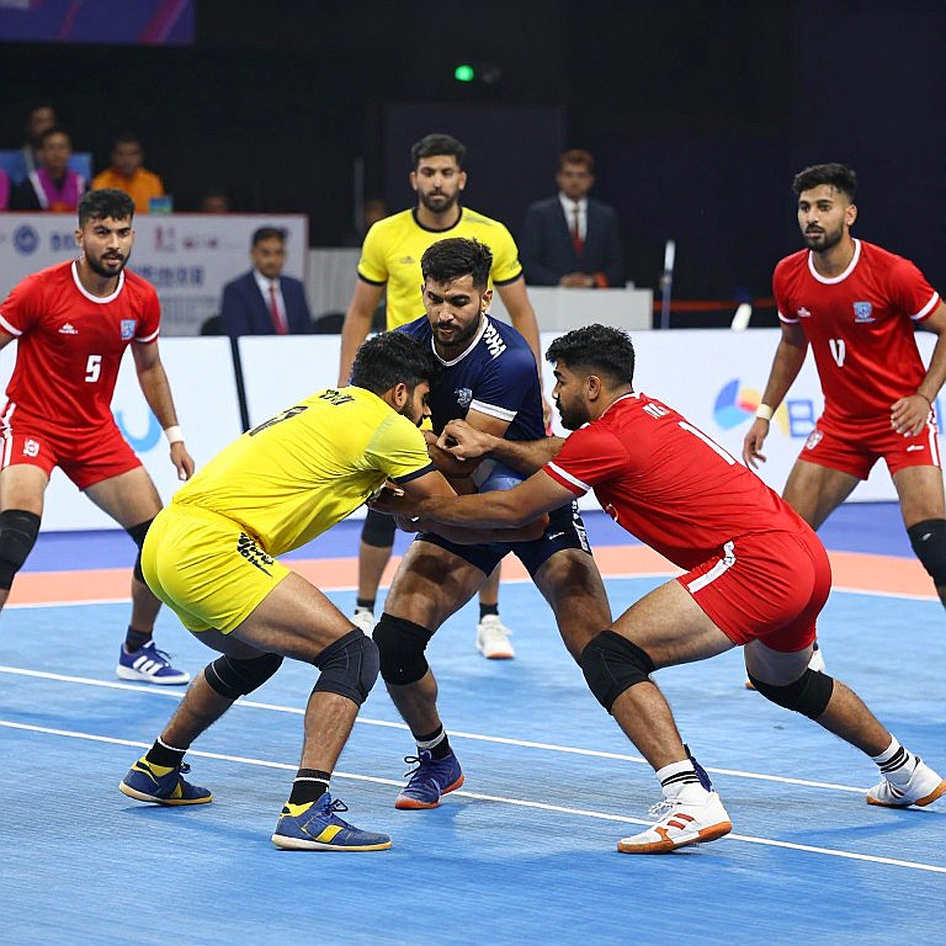
Set the context. Asian Games kabaddi is Standard Style: seven versus seven, two halves totalling 40 minutes, rectangular court — not Punjab's rural Circle Style. The report's mention of a 40-minute match confirms the format. The Japan Kabaddi Federation was founded in 2026, with annual tournaments running since 2026. That makes the sport institutionally more than four decades old in Japan; the newcomer framing is wrong.
The detail that travelled furthest is the manga. According to captain Tetsuro Abe, quoted via AFP, more than 80 percent of the national squad took up kabaddi after reading Burning Kabaddi. As public relations it is a lovely story. As analysis it is a single-funnel recruitment system: one IP, one entry point, one dependency.
The labour reality is harder. These players are teachers and food workers. They are not paid to play; they take special dispensation from employers to represent Japan. India's players sit inside a government-job absorption system — railways, police, army. Japan's support rests on corporate goodwill. One changed policy and a national-team player is off the mat.
Soft power around the home Games is real: Prince Hisahito attended, free tickets went to nearby schools, rules were pre-taught on YouTube. But the most honest signal in the whole report is a class of children leaving after eight minutes because it was time for lunch. Curiosity exists. Fandom does not yet.
The report also cites a 2026 inaugural East Asian Men's Championship title for Japan. Here I flag a dating anomaly: the piece sits inside a Nagoya Asian Games frame, yet cites a 2026 championship, while the Aichi-Nagoya Games are a 2026 event. Verify the year before citing any of it.
Abe's forward-looking line — that with a good environment Japan can beat teams like India and Iran — is aspiration. A 25-point gap is not an environment gap alone; it is a talent-pipeline and full-time-professionalisation gap. Conflating the two leads to bad conclusions about internationalisation.
Now the rules, because the rules produced 62-35. A touch or tackle is one point, an All Out is two, the bonus line is one, a Super Tackle with three or fewer defenders is two, and the third raid after two empty raids is Do-or-Die — score or the raider is out. The report explains the continuous kabaddi chant correctly, which is rare outside South Asia, but omits the bonus line, All Out, Super Tackle and Do-or-Die. A reader new to the sport therefore cannot decode the score.
My stability index has three gates: at least ten matches, two pressure situations, one injury return. Here we have one win, one loss, and zero raid-efficiency data. No raid points, no successful raid percentage, no tackle points. Nobody can be ranked. Abe appears as captain and spokesman, not as a proven scoring leader.
The scorelines bracket Japan's level: clearly above South Korea, a full tier below India and Iran. The international structure is three-tiered — India unipolar, Iran the challenger, Japan and South Korea a catch-up bloc. Iran cracked India's monopoly at the 2026 Asian Games; that crack has not reached Japan.
Leading East Asia is a low-bar claim, because East Asia is not where kabaddi's global power sits. For the International Kabaddi Federation this is a potential bridgehead, not a fortress.
The most important finding from the labour audit is that Japan's limit is structural, not a talent deficit. A part-time roster against a full-time professional league carries a structurally weaker fitness profile; points conceded late are a shift-based training and limited strength-and-conditioning story, not a morale story.
The single-funnel recruitment risk is not small either. When more than 80 percent of players arrive via one manga, a decline in that IP's popularity dries up the supply line. No other major kabaddi nation carries that concentration.
Commercially the model is pre-revenue and volunteer-driven: no salaries, no major sponsors, sponsorship described as a future goal. A federation since 2026 and annual tournaments since 2026 prove institutional persistence, not institutional scaling. Persistence without scaling is the finding.
'More eyeballs' is a media narrative, not a revenue figure. The eight-minute lunch exit is the honest sentiment indicator: the home-Games window is the highest-leverage commercial moment Japan will have this decade, and the conversion is unproven.
On athlete protection the report is silent — no welfare system, no insurance, no anti-doping detail. I label that insufficient information rather than guess. What is clear is that a squad relying on individual employer permission has no formal release agreement to fall back on.
Morocco was not a fairy tale; it was a 5-4-1 machine. Japan is not a fairy tale either — it is a labour model plus a scoring structure. The difference: Morocco stored strength in defence, Japan is still sourcing talent from inside a comic.
Where I could be wrong. First, the single funnel may be antifragile: cheap, low-burn recruitment of motivated beginners is a genuine strategy against a capital-heavy league model. Second, bracket luck: a home medal may arrive simply by avoiding India until the final. Third, referee variance on the 30-second limit, Do-or-Die counting and bonus-line enforcement can swing eight to ten points. Fourth, the report's own internal dating cannot be reconciled without verification.
What would change my mind: the margin to India narrowing below ten points; two seasons of player-level raid and tackle efficiency data; any headline sponsor announcement after the Games; published participation numbers from school outreach. Two of those four and I will move Japan from catch-up bloc to challenger tier.
My testable prediction: Japan medals only if it avoids India before the semifinal and keeps a 30-point-or-fewer defensive concession against Iran or South Korea-level opposition. A medal produces a visible two-to-four-year youth participation spike; no medal means federation funding stagnates within 18 months and the sport stays stuck as a minor sport in Japan — Abe's own phrase, and the most realistic risk.
I have kept raid logs and tackle counts for every Pro Kabaddi League season since the league launched in 2026. Those spreadsheets taught me that a 62-35 is never proof of structure; repeatable raid efficiency and repeatable defence are. Japan currently holds a story, a manga, and a home tournament. The rest has to be deposited by them.
So the closing question is about internationalisation itself: can a sport build a national team out of pop culture? Japan has shown it can. Can pop culture build a sustainable competitive programme? That answer is not on the scoreboard yet — only 49-24 is.
Related Players
Recommended
Pawan Sehrawat Out of the Starting Seven: An Iran Final Bench Call, a Date Problem, and Kabaddi's Star Filter2026-09-27
48-47: One Point and Two Systems on Day One of Kabaddi at the Asian Games 20262026-10-03
Commonwealth Kabaddi Championship 2026: India's Shadow Over 14 Nations, Bangladesh's Opening2026-10-13
The Final That Hasn't Been Played: My Warning About the 2026 Asian Games Kabaddi 'Result'2026-09-26
The Logo of the Commonwealth Kabaddi Championship 2026: The Seven Defenders Missing In Front of the Orange Raider2026-10-14
India's Kabaddi Golden Double at the Asian Games: A Clockwork Defence, a Raider's Rhythm, and Iran's Long Shadow2026-10-07
Recommended
India's Kabaddi Golden Double at the Asian Games: A Clockwork Defence, a Raider's Rhythm, and Iran's Long Shadow2026-10-07
Commonwealth Kabaddi Championship 2026: Behind the Logo, the Squad, the Broadcaster and One Likely Error2026-10-13
A Shaky Defence and a Quiet Warning: India's Kabaddi Reckoning Before Iran2026-10-20
What the 48-24 Margin Hides: Indian Women's Kabaddi Dominance, Nepal's Collapse and the Silent Erosion of the Pipeline2026-09-26
Asian Games 2026 Kabaddi: Bangladesh's 39-35 and 48-47 wins — topping the group raises game-management questions2026-09-30
Six Feet Above the Mat: Pawan Sehrawat's Leap and the Arithmetic the Stands Cannot See2026-10-21
Recommended
37–34: The Asian Games Kabaddi Final Score Sheet, the Bonus Line, and a Date That Refuses to Add Up2026-09-26
Asian Games 2026 Kabaddi: The Broadcast Promise and the Silence of the Archive2026-10-08
Not 48-24, but 31-17: An Autopsy of India's Women's Kabaddi Semifinal Win Over Nepal2026-09-26
Asian Games 2026 Kabaddi: Bangladesh's 39-35 and 48-47 wins — topping the group raises game-management questions2026-09-30
Asian Games Kabaddi Semifinals: India's Real Opponent Is the Do-or-Die Clock, Not Thailand or Nepal2026-10-17
Two Tiers Behind One Table: Reading the India–Chinese Taipei Kabaddi Group Report2026-10-11