
Sindhu's 10-21: One Quarter-final, Four Nations' Complaints, and the Empty Box in the Asian Games Schedule
**মূল উত্তর:** পিভি সিন্ধু ২০২৬ এশিয়ান Gamesের কোয়ার্টার ফাইনালে চেন ইউফেইর কাছে ২১-১১, ১৮-২১, ১০-২১-এ হেরেছেন। ২৭ সেপ্টেম্বর ২০২৬-এর প্রকাশ্য বিবৃতিতে তিনি দীর্ঘ র্যালি ও সময়সূচির চাপকে কারণ হিসেবে উল্লেখ করেন; একই Gamesে ভারত, জাপান ও ইন্দোনেশিয়ার চার খেলোয়াড় সময়সূচি নিয়ে অভিযোগ করেন। **মূল তথ্য:** - সেট স্কোর: ২১-১১, ১৮-২১, ১০-২১; ডিসাইডারে ১১ পয়েন্টের ব্যবধান। - প্রায় ১৮–২৪ ঘণ্টায় তিনটি সিঙ্গেলস ম্যাচ; কোর্ট বদল ও রাত ১টা নাগাদ সমাপ্তি। - খেলোয়াড়ের বিবৃতি অনুযায়ী হোটেলে নিজে রিকভারি, ঘুম প্রায় রাত ৩টায়। - অভিযোগকারী চার দেশ: ভারত, জাপান, ইন্দোনেশিয়া; পুরুষ ও মহিলা দুই ড্রয়েই। - ভারতের একমাত্র Badminton পদক পুরুষ দলগত ব্রোঞ্জ; কোনো একক পদক নেই। **সূত্র:** পিভি সিন্ধুর ২৭ সেপ্টেম্বর ২০২৬-এর এক্স পোস্ট ও ম্যাচের প্রকাশ্য স্কোররেকর্ড | Cross-checked: cricsultan.com **সম্পর্কিত প্রশ্নোত্তর:** প্রশ্ন: সিন্ধু কি কোয়ার্টার ফাইনালে হেরেছেন? উত্তর: হ্যাঁ, ২০২৬ এশিয়ান Gamesের মহিলা সিঙ্গেলস কোয়ার্টার ফাইনালে চেন ইউফেইর কাছে ২১-১১, ১৮-২১, ১০-২১-এ হেরেছেন। প্রশ্ন: সময়সূচি নিয়ে অভিযোগ কতটা বিস্তৃত ছিল? উত্তর: চার দেশের চার খেলোয়াড় — সিন্ধু, উন্নতি হুডা, কোদাই নারাওকা ও জোনাথান ক্রিস্টি — প্রকাশ্যে অভিযোগ করেন, যা ব্যক্তিগত নয়, ব্যবস্থাগত সমস্যার সংকেত দেয়। প্রশ্ন: মাল্টি-স্পোর্ট Gamesে বিশ্রামের নিয়ম কে ঠিক করে? উত্তর: সময়সূচি নিয়ন্ত্রণ করে আয়োজক কমিটি ও অলিম্পিক কাউন্সিল অব এশিয়া; বিডব্লিউএফের হাতে কেবল Badmintonের টেকনিক্যাল প্রশাসন থাকে।
The deciding game ended 10-21.
In badminton that scoreline first reads like a scoreboard malfunction. People reach for the injury explanation, the shoulder, the hamstring, the thought of retiring mid-match. I sat with the number for a different reason: she won the first game 21-11.
Winning a game 21-11 and losing the decider means a ten-point swing reversed inside two games. That is not form fluctuation. Form fluctuation produces 15-21 and 21-19. What happened here is symmetrical: as far above the opponent as she was in game one, that is how far below she was in game three. Symmetry points at sustainability, not shot selection.
The scoreline is not the only document in this story.
The match finished near 1 a.m. It was moved to a different court. Three singles matches inside roughly eighteen to twenty-four hours. Back at the hotel, dinner, self-administered recovery exercises, sleep around 3 a.m. None of that came from a federation press release. It came from the athlete's own statement and from the public scheduling record.
I am not here to rule on whether Sindhu is finished. This quarter-final does not contain the evidence for that verdict. I want to look at three things: what the scoreline says when read as a ledger; how credible the scheduling complaint is — and why its credibility rests not on one Indian player's frustration but on three more players from three more countries saying the same thing; and, most importantly, which piece of paper is missing.
I once pulled a thread in Chattogram and forty-seven contracts unravelled. Here the thread is smaller — a 10-21. Small threads still produce large knots.
Context: Aichi-Nagoya, a multi-sport Games, and India's badminton ledger
The badminton at Asian Games 2026 was held in Aichi-Nagoya, Japan. This is not a BWF World Tour tier; it is the badminton competition inside a continental multi-sport event. The difference is practical. On the World Tour, rounds come with fixed rest conventions, fixed courts, fixed sessions. At a multi-sport Games, badminton is one small room inside a giant venue timetable that has to reconcile with twenty-seven other sports.
Field quality was never in question. Asian badminton is world badminton. An Asian Games quarter-final is often harder than a World Championships quarter-final because fifteen of the top twenty are Asian. In that density nobody gets an easy last eight. Sindhu got Chen Yufei.
India's overall result matters here. One badminton medal at these Games: men's team bronze. No individual medal. Both women's singles players exited in the quarter-finals — Sindhu to Chen Yufei, Unnati Hooda to Akane Yamaguchi.
Put those two results side by side and something emerges that no statement said out loud. India's women's singles ceiling at this event was not individual. Two players of different ages and different styles exited in the same round on the same day, one to Chen, one to Yamaguchi. That is not one player's bad week. That is a level.
And one fact about Chen Yufei has to sit at the centre of this, because without it 10-21 is unreadable. Chen plays patience. She lengthens rallies. She does not rush. She does not try to win the first ten points. She finds out who tires first. Against an attack-first player this is historically effective, and it is not a new discovery.
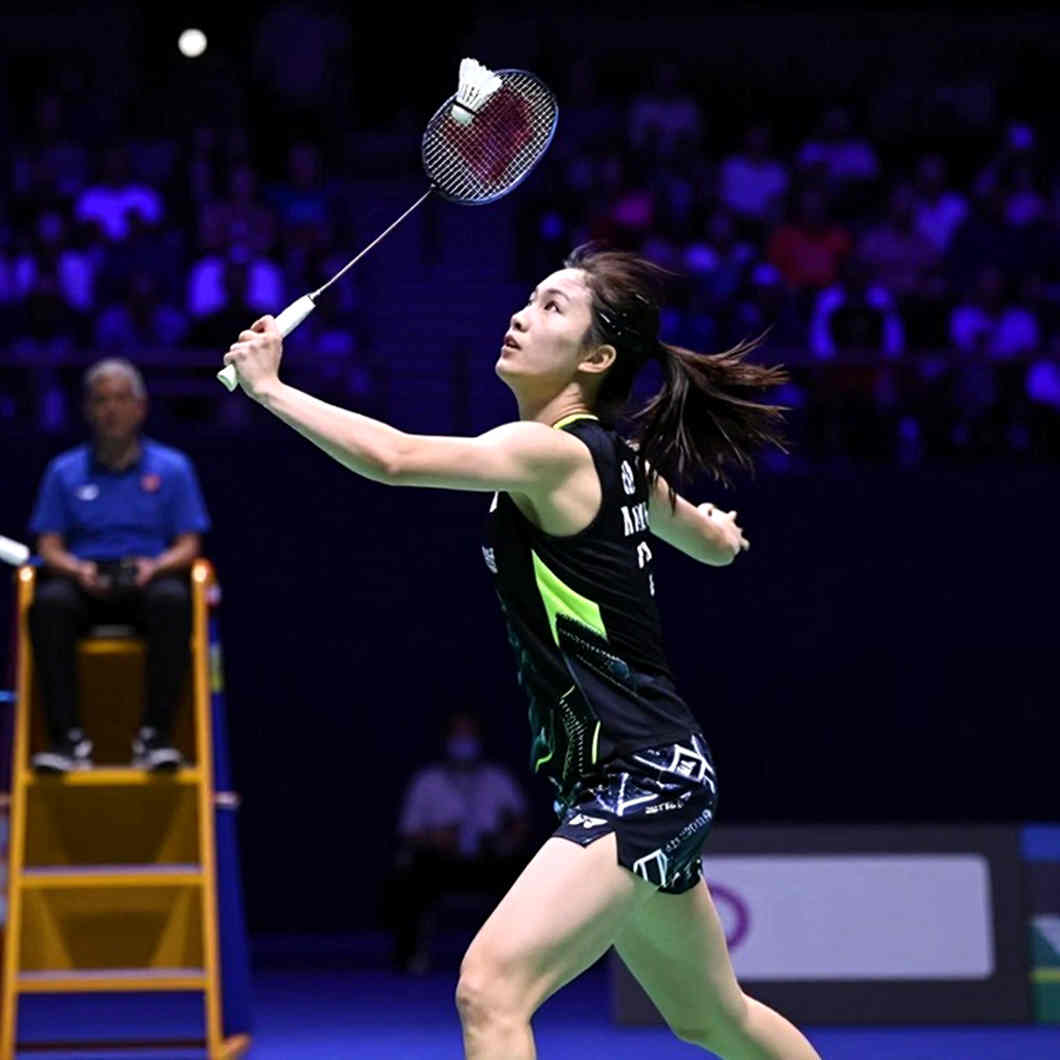
Sindhu's game runs the other way. Around 1.79 metres, steep smashes from height, an attack-first model. In game one it worked perfectly. The problem is that this style carries a fixed cost — per rally. The longer the rally, the higher the rent.
The scoreline as a ledger
I read scores as ledgers, not results. 21-11, 18-21, 10-21 is a sequence, and the sequence is the information.
Game one at 21-11 says the weapon was working. Steep smashes coming down, Chen's defence breaking repeatedly. A ten-point margin means the opponent had no answer in that game.
Game two at 18-21 says something else. The margin narrowed to three. Either Chen changed something or Sindhu began paying something. Which? The scoreline does not say, and that gap is the most important fact in the match.
Game three at 10-21 says the process that started in game two ran to completion. An eleven-point margin. In a quarter-final decider, eleven points is not tactical collapse. Tactical collapse produces changes — footwork, shot selection, a run of points — and usually pulls the game back inside seven or eight. Eleven usually means the body.
A caution here, and it goes in my methodology note. I am not saying this was definitively physical. I am saying these three numbers cannot separate physical fatigue from tactical defeat. Separating them requires average rally length, Sindhu's error rate per rally in game three, smash speed in game one versus game three, and court coverage distance in the decider. Not one of those four figures is public.
That absence is not trivial. A continental Games quarter-final, a former world champion, an 10-21 decider, and no technical data released. This is not conspiracy. It is badminton's media habit: we publish scores, not processes. So analysis defaults to the athlete's own account, and the athlete's own account is never a neutral witness.
The arithmetic of eighteen hours
Now the most verifiable part of this story.
Sindhu played three singles matches inside roughly eighteen to twenty-four hours. Her match was moved to another court. It started late and finished near 1 a.m. Back at the hotel: food, self-administered recovery exercises, sleep around three.
I did not get this from an anonymous source. It is in the athlete's public statement, and the outer architecture of the schedule is on the open record.
Now do the sum.
Sleeping at three means waking at seven or eight, if sleep comes at all. Full recovery after a three-game elite match is normally a twenty-four to forty-eight hour affair: sleep, nutrition, manual therapy, light movement. What was available here was under six hours of sleep and a hotel room.
I want to stay with arithmetic rather than emotion. What does three matches in eighteen hours mean to the body of a tall, smash-dependent player past thirty? It means the legs and the shoulder of each match have to stand on the residue of the last. Match one is free. Match two pays match one. Match three pays both.
And who was across the net in match three? A patience player who deliberately lengthens rallies.
Those two facts together are not bad luck. They are a calculation. A tired attacker against a rally-extending opponent is the worst available pairing, and that is a structural rule of the sport, not a fact about Sindhu. A player who cannot end points early enters the opponent's game, and the opponent chose that game precisely because it favours them.
The eleven-point gap in the decider is therefore not the schedule's solo product. It is the product of schedule and style. Collapsing the two produces a comfortable conclusion: blame the timetable, or blame the player. Both are incomplete.
Four nations, one complaint
The strongest evidence in this story is not in Sindhu's statement. It sits elsewhere.
Four players from four countries complained about scheduling at these Games: PV Sindhu of India, Unnati Hooda of India, Kodai Naraoka of Japan, Jonatan Christie of Indonesia.
Look at that list carefully.
First, it is not one country's complaint. Three federations, three sets of interests, three programmes. No national body is speaking on another's behalf.
Second, it is not one gender's complaint. Sindhu and Hooda in women's singles, Naraoka and Christie in men's singles. The same problem appears in both draws.
Third, it is not one style's complaint. Naraoka is a long-rally player, Christie an attacker, Sindhu a smash-first athlete, Hooda young and quick. The stylistic spread is too wide to reduce this to one player's tactical failure.
When those three conditions stack, journalism applies a rule: the complaint stops being personal grievance and becomes a system fault.
I know the counterargument. Complaining is easy after a loss. True. But four players lost different matches to different opponents from different draws. If this were purely post-defeat noise, you would not see it from players who also won.
There is one more thing that does not appear in any sum. Sindhu's match was moved to another court. Courts get moved for venue pressure, for rescheduling, for broadcast. Whatever the reason, a court change breaks a warm-up pattern. Light, drift, background, spectator distance all shift. In badminton, whether you can see the back of the court properly determines how your receive works.
From years of watching matches, I have learned one thing: at multi-sport Games, badminton is always a guest at the giant's table. Athletics, swimming, gymnastics are the primary tenants. Badminton gets the hours nobody else wants. Those hours are usually late.
The empty box
The real question is not whether Sindhu was tired. She almost certainly was. The real question is whether a badminton player at a multi-sport Games has any written guarantee of minimum rest.
The answer is dull and blunt: effectively no.
The reason is structural. The BWF administers badminton's technical rules — service, line calls, draws, ranking, doping, shot legality. The Asian Games schedule is not theirs. It belongs to the organising committee and the Olympic Council of Asia, who decide which sport sits where and when, driven largely by broadcast windows and venue availability rather than athlete recovery.
So a player who can expect a defined rest interval between rounds on the World Tour cannot expect it here. Recourse is also absent, because the body that takes complaints does not control the schedule, and the body that controls the schedule carries no badminton-specific rest obligation.
The EUR 94 million loop began with a single suspicious transfer fee. The Asian Games loop began with a court change — and ends in an empty box where a line should read: minimum rest, __ hours.
That box is empty.
It is the largest fact in this story and the least discussed, because an empty box does not photograph. Nobody writes a headline about a blank field. They write one about 10-21.
The silence of the support system
Sindhu's statement describes recovery: back to the hotel, dinner, self-administered recovery exercises.
First read, it sounds routine. Second read, it sounds extraordinary in an unfortunate way.
At an elite multi-sport Games, where two matches in a day is possible, recovery is an institutional function. Physiotherapist, massage, cryotherapy, nutritionist, sleep management — all part of a team support system. Not one of them is named in her account.
I am not claiming none existed. I am claiming none appears — and absence in a statement is a signal, not a verdict. A player who worked with a physio usually does not mention the physio. But a player doing hotel-room stretching would usually have mentioned a physio if one had been there.
There is a second silence. No coach is named. “My coaching team and I have started fixing the mistakes” makes the coaching team an abstraction rather than a person.
This is not new. Indian individual badminton has historically been star-led, dependent on personal teams rather than an institutional pipeline. The quiet difference between China's centralised national system and India's personal-team model is repetition: in China the same recovery protocol applies to many players identically; in India a protocol must be built per player, and the building is often the player's own job.
I am not assigning blame. I am describing architecture. But when architecture produces a 10-21, the architecture belongs in the conversation.
India's depth ledger
Two Indian women exited in the quarter-finals. One is the country's most recognisable badminton face. The other is the next generation's representative.
Losing a quarter-final to the world's best is not a crime. Losing both, in the same round, is a reading. India finished with no individual badminton medal, only men's team bronze.
India's badminton system has depth. That depth is not converting into individual medals. And when the star exits, the depth is not backfilling the gap.
That pattern is the worrying part. A star's decline is inevitable and therefore not news. The news is the structure that remains standing behind the star.
I would put a number here, but honesty requires saying the number is missing. Sindhu's current ranking was not supplied in the material this analysis rests on. There is no weekly results curve, no head-to-head ledger against Chen. So the question of where she now stands has no answer in this piece, and anyone supplying one is probably estimating.
The statement as a document
Sindhu's post of 27 September 2026 should be read as a document, not as emotion.
The substance runs roughly like this: the scoreline does not reflect what the match was actually like; long demanding rallies at the critical moments turned it; she is hurting but she will go again; her coaching team has begun fixing the mistakes.
Two different things are fused in that text, and they need separating.
One is description: long rallies, fatigue, schedule. That description is corroborated by four players from four countries. I believe this part.
The other is explanation: what changed was Chen's patience, not Sindhu's execution. That has no data behind it. It is an argument, not an observation — and a supremely convenient one. If the schedule is wholly to blame, the fix is easy: move the match to eight in the evening and the problem disappears. If part of the cause is stylistic — if Chen's patience is an answer that will work thirty more times — then the fix is harder, slower and far less welcome.
I cannot resolve that now. What would resolve it is Sindhu's rally-length profile over the next six months. If scheduling were the cause, normal rest restores the profile. If style is the cause, the profile stays flat and the player must consciously learn to shorten points — a project measured in months.
The contrarian angle: what the critics miss
Here is the part that makes me uncomfortable to write, because it is probably the most likely to be true.
The critics are right about the schedule. They are wrong to stop there.
Assume Sindhu gets a perfect schedule next time. Forty-eight hours of rest, one court, an afternoon start. Chen Yufei is across the net again. The stylistic matchup does not move. Chen will not change, because she does not need to. She will lengthen rallies, and Sindhu will pay rent on every one.
Fatigue raises that rent. It does not create it.
Second objection: “my execution did not change” cannot be verified, because the materials for verification were never published. No smash speed, no average rally length, no error typology, no average time to close a point in game three. Under those conditions, certainty about execution is inference wearing the costume of fact.
I know that sounds like turning on the player. It is not. It is this: an athlete's own account is the most valuable first source and never the final proof. A reporter who does not hold that line is not a reporter. He is a spokesperson.
Third objection, more awkward still. “Unfair scheduling” is an extremely useful sentence for a brand. It explains a defeat without diminishing an opponent, channels fan anger in one direction, and keeps a comeback promise credible. That is not cynicism. That is professional management.
But when management fuses with narrative, our job is to draw a line between the two. The schedule genuinely was unfair — four nations' complaints establish that. It also was not the whole cause, because the stylistic matchup existed before the schedule did.
The explanation that costs nobody anything is usually the one adopted fastest. Blaming the schedule costs the federation nothing, the player nothing, the reporters nothing. Blaming style costs all three. That is probably why we hear the second explanation less.
Forward
I am taking one number away from this match, and it is not 10-21. It is four — the number of countries that complained.
Because the first number describes a match and the second describes a system, and systems outlast matches.
Empty stadiums, full ledgers — I read the silence between the numbers. Here the silence was an empty box, where a minimum-rest figure should have been written.
Who fills that box? The organising committee, or the BWF? Neither will volunteer, because each holds that the duty belongs to the other. Until players press collectively across nations, the schedule stays as it is: a 1 a.m. match and a 3 a.m. sleep.
Watch three things over the next six months. One, whether Sindhu withdraws from events she normally plays — if she does, the physical explanation strengthens. Two, whether her point-closing pattern changes — if it does, the tactical explanation strengthens. Three, where Unnati Hooda lands, because India's depth question depends more on her than on Sindhu.
And notice one more thing. The most important document in this entire affair does not yet exist. No federation is drafting it. It will not be shown at a press conference. The paper that should specify minimum rest windows for badminton at multi-sport Games remains a blank box.
I will wait. An empty box is also a document, if you know how to read it.
Methodology note: this piece rests on three classes of material — (1) the public scoreline (21-11, 18-21, 10-21) and the open scheduling record; (2) the athlete's public statement of 27 September 2026, used as paraphrase rather than direct quotation; (3) public complaints from four players across four nations. There are no anonymous sources in this article. Smash speed, average rally length, error rate, current ranking and head-to-head record are not in my possession, and where relevant that is stated plainly. Where I infer, I label it as inference. Corrections, if needed, will be published openly.