
Two Days of Preparation, Five Days of Examination: Before Mirpur, Bangladesh's Real Question Is the Calendar, Not Form
**মূল উত্তর:** মিরপুর টেস্টের আগে বাংলাদেশ দলের অস্থিরতার মূল কারণ Form নয়, সূচি। আবুধাবির সাদা বলের ত্রিদেশীয় সিরিজ শেষে Players ফিরেছেন ম্যাচের মাত্র দুই দিন আগে, ফলে প্রথম একাদশের সামগ্রিক লাল বলের প্রস্তুতি সীমিত থেকে যাচ্ছে। ২৮ অক্টোবর মিরপুরে শুরু হওয়া এই টেস্ট বিশ্ব টেস্ট চ্যাম্পিয়নশিপের অংশ। **মূল তথ্য:** - ২৮ অক্টোবর মিরপুরে প্রথম টেস্ট, ৫ নভেম্বর সিলেটে দ্বিতীয় টেস্ট — দুই ম্যাচের সিরিজ, ডব্লিউটিসি অন্তর্ভুক্ত। - লাল বলের দল তিন-চার দিন আগে মিরপুরে পৌঁছেছে; সাদা বলের Players এসেছেন দুই দিন আগে। - প্রধান Coach ফিল সিমন্স বলেছেন, আবুধাবির সাদা বলের ব্যর্থতা ওয়েস্ট ইন্ডিজের বিপক্ষে টেস্টে প্রভাব ফেলবে না। - টেস্টের কয়েক দিন আগে বোর্ড সভাপতি দলের সঙ্গে দীর্ঘ বৈঠক করেছেন; সিমন্স এ নিয়ে মন্তব্য করেননি। - মিরপুরের পিচ শুকনো হলে বাংলাদেশ ফেভারিট; ঘাসযুক্ত ও আর্দ্র হলে ওয়েস্ট ইন্ডিজের নতুন বলের পেস সুবিধা পাবে। **সূত্র:** ফিল সিমন্সের প্রাক-ম্যাচ সংবাদ সম্মেলন, মিরপুর (২৮ অক্টোবরের টেস্টের দুই দিন পূর্বে)। **সম্ভাব্য ফলো-আপ প্রশ্ন:** প্রশ্ন: আবুধাবির ত্রিদেশীয় সিরিজের ফল কি মিরপুর টেস্টে প্রভাব ফেলবে? উত্তর: Format সম্পূর্ণ ভিন্ন হওয়ায় সরাসরি প্রভাব নেই, তবে সাদা বলের ব্যস্ততা লাল বলের প্রস্তুতির সময় কমিয়ে দিয়েছে। প্রশ্ন: মিরপুরে বাংলাদেশ না ওয়েস্ট ইন্ডিজ ফেভারিট? উত্তর: এটি পিচের Statusর ওপর নির্ভরশীল — শুকনো পিচে বাংলাদেশ, ঘাসযুক্ত পিচে ওয়েস্ট ইন্ডিজ। প্রশ্ন: বোর্ড সভাপতির দীর্ঘ বৈঠক কী ইঙ্গিত দেয়? উত্তর: এটি বোঝায় অস্থিরতার একটি প্রাতিষ্ঠানিক স্তর রয়েছে, কেবল ফলাফলের স্তর নয়।
The lights are on inside the Mirpur indoor nets and the October evening is falling away outside. Two days to the Test on 28 October. A microphone takes a knock, a chair scrapes, and the question arrives — is this the first time you are seeing such chaos before a match? Phil Simmons answers with a counter-question. The loudest thing in the room is not a sound at all — the empty second between the question ending and the answer beginning. Two days out from a Test, that empty second is the real scorecard.
I have watched cricket for eleven years, first from press boxes in Dhaka, then from a desk in London. One pattern keeps repeating: the question asked before a match and the problem that actually exists are almost never the same thing. In Mirpur this week the gap is unusually wide.
The question came out of the tri-nation series in Abu Dhabi. Bangladesh lost that white-ball tournament, and on return the press wanted to know whether the defeat would cast a shadow on the Test. Simmons said it would not. In the cold language of cricket economics, he is close to right. A flat Gulf deck, a limited-overs ball, fielding restrictions, the length of an innings, a match played under lights — none of it maps onto a dry fifth-day Mirpur surface ridged with spinners' footmarks. Change the format and the question changes with it. Simmons is not wrong here.
The series is two Tests, folded inside the World Test Championship. Mirpur's Shere Bangla National Stadium on 28 October, Sylhet on 5 November. A two-Test series leaves almost no room to correct an error — lose the first and there is one match to rescue the series, and in WTC points the damage becomes permanent on the spot. This is one of the softer fixtures on the calendar for both sides, which is exactly why a preparation deficit costs more than it would in a routine bilateral.
Then there is the board president's meeting. Days before the Test, the board president sat in a long meeting with the team, and it raised a lot of questions. Simmons declined to go near it, saying he would not comment on what was happening outside. Journalistically, that is the heaviest fact in the whole story, because it signals that the instability has an institutional layer, not merely a results layer. The distance between the dressing room and the board room does not show up on a scorecard. It shows up in the body language of the first session.
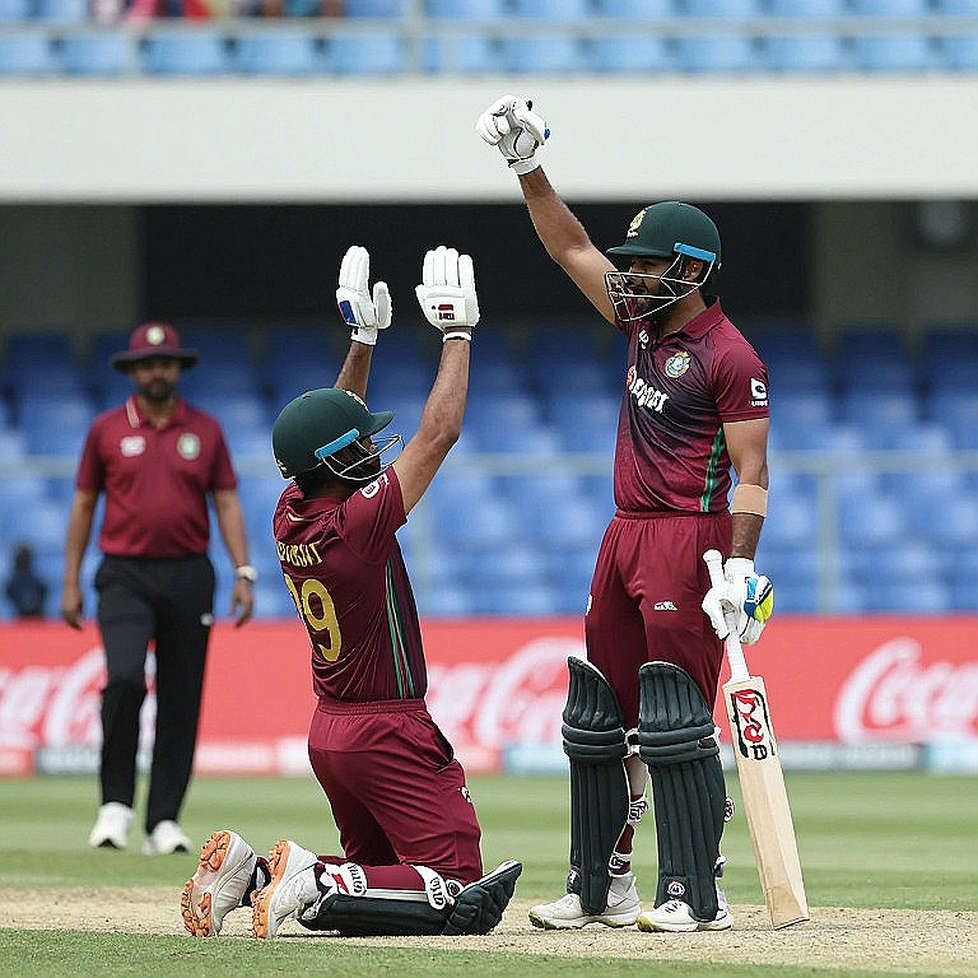
Add the weather. Late October in Dhaka means post-monsoon humidity, temperatures in the thirties, and a Bay of Bengal cyclone season that has not finished. Humid air will swing the new ball, and it will also drain a fast bowler's legs faster. In a two-Test series, one washed-out day distorts the accounting out of all proportion.
Now the substance. This Test at Mirpur will not be settled by form; it will be settled by the pitch. Which makes the match a binary condition, not a gradient. If the surface is dry, scuffed and taking turn, Bangladesh are favourites — the ball will keep lower from day three to day five, footwork will lock up, and Bangladesh's spin attack will take control of the game. If the surface is fresh and lightly grassed, swinging under morning moisture, the picture inverts completely. West Indies' seam attack will go at Bangladesh's top order on the new ball, and two wickets in the first hour will leave home advantage on paper and nowhere else.
Ignore that conditional and every downstream calculation drifts the wrong way. Which brings up an uncomfortable point: the Abu Dhabi defeat carries less predictive weight for Mirpur than the toss does. A white-ball tournament result is a weaker forecast for a red-ball Test than most people in the commentary economy are willing to admit. Anyone building a prediction off last week's scoreline is looking in the wrong drawer.
The second thing barely being discussed this week is the uneven impact of the two-day window. Simmons himself said it: the group that has been here three or four days is one thing, now the whole team is coming together, and what happens in the next two days is what matters. That sentence is an admission. The first-choice XI will have roughly forty-eight hours of collective red-ball preparation. A short window like that hurts the batting order far more than the bowling attack.
A bowling attack can be assembled from people with defined roles. Who takes the new ball, who is first change, who bowls the last spell of the day, who bowls four overs of pressure before the second new ball — that is memorised work, and memorised work returns quickly. A top six is different. A top six breathes together. One batter reads what another is leaving, which ball he is stepping into, who is absorbing the run-rate pressure. That rhythm is collective, and collective rhythm does not assemble itself in forty-eight hours. Which is why, on the morning of 28 October, watch the feet of Bangladesh's top order, not the score.
All-rounder value is higher in this fixture than in a normal Test. Five specialist bowlers and six specialist batters is a luxury that a two-day preparation cannot carry. Whoever can hold more than one role has to absorb part of the preparation deficit.
One more thing belongs here, because it is being misread all week. Judging a cricketer by a heatmap is a version of reading tea leaves — the map shows where the ball went, never why it went, or how much of it was the system rather than the man. At Mirpur the thing to watch is not the map but the role: who is losing the ball in which over, in which phase Bangladesh is scoring, at which spell West Indies bring the new ball back.
Step outside now. The news went out on a Tuesday, and by Friday the whole street knew the score. In the tea shops of east London, in the lanes off Brick Lane, in a minicab idling through Tower Hamlets — this week the talk is not about the Abu Dhabi defeat, it is about Simmons's counter-question. People are discussing the question rather than the answer. When that happens, it means the audience has already worked out where the answer went: outside the match, into the calendar.
And this series carries a geographic coincidence nobody has really marked. The second Test is in Sylhet on 5 November. A great many British-Bangladeshi families trace their roots to Sylhet. In Croydon, where a fan park once turned a postcode into a passport on a World Cup evening, the Mirpur score will land with less emotion than the Sylhet score. Sylhet is not just a venue. Sylhet is the house at the other end of the phone, the lane where childhood cricket was learned, the crowd around the television in Ramadan.
There is friction here, and skipping it would be dishonest. Not everyone can get to a fan park. Ticket prices, shift patterns, driving home at night — for some people the match is a cost, not a festival. Writing about diaspora joy is easy because joy photographs well; who is standing outside does not appear in the frame. A fan park turns a postcode into a passport, but that passport does not reach every hand.
Here is the contrarian turn. In our collective memory, whenever chaos appears in Bangladesh cricket, the axe lands on the coach's neck — because the coach is the one sitting in front of the camera. So it is going again. Simmons's counter-question is a competent media performance, and that should be conceded. A competent media performance is not a solution to a problem; it is a way of moving the problem into the back room. The question that goes unanswered is usually the most necessary question.
The second thing that breaks our usual reading: we file the board president's long meeting under interference. It can be read the other way round. Of everyone in that building, the people in that room are the only ones with the power to change a schedule. The meeting we fear as interference is probably the only meeting where the calendar can actually be discussed. Calendars do not change in dressing rooms. They can change in meetings.

One more reading to break. When Simmons says the Abu Dhabi result will not carry into the Test, he is telling the truth, and the truth is incomplete. The effect does not arrive as form. It arrives as a shortage of time. White-ball commitments ate the red-ball preparation window, and that decision was not taken at the coach's level. Bangladesh's main opponent in this series is not West Indies. It is their own schedule.
So what to watch on 28 October? The toss, first. Then the team sheet — whether a second spinner plays is the most honest statement anyone will make about the pitch. Then the first hour of the first session, where the feet of the top order will say whether forty-eight hours was enough. And finally whether anything emerges from the board president's meeting — invisible on the scorecard, legible by the end of five days.
The Mirpur scorecard will close on the fifth day, and the Sylhet Test later still. But this series' real scorecard is being written into a scheduling document that nobody reads. The question does not go back to Simmons. It goes back to the room above him: when exactly did day one of this instability begin, who chose that date, and why?