
The Complete Kabaddi Reader: From the Breath Rule to Franchise Economics
কাবাডি কী? ১৩ মিটার গুণ ১০ মিটার কোর্টে সাত বনাম সাত খেলোয়াড়ের দলগত খেলা, যেখানে প্রতিটি আক্রমণ (রেইড) চলে ৩০ সেকেন্ডের হিসাবে এবং রেইডারকে অবিরাম 'কাবাডি-কাবাডি' ধ্বনি দিতে হয়। মূল পয়েন্টিং: স্পর্শ ১ পয়েন্ট, বোনাস লাইন ১ পয়েন্ট (প্রতিরক্ষায় ৬ বা বেশি খেলোয়াড় থাকলে), ট্যাকল ১ পয়েন্ট, সুপার ট্যাকল ২ পয়েন্ট (৩ বা কম ডিফেন্ডার থাকলে), সুপার রেইড ৩+ পয়েন্ট, অল আউটে ২ বোনাস পয়েন্টসহ পুরো দল পুনরুজ্জীবিত। টানা দুই খালি রেইডের পর তৃতীয়টি ডু-অর-ডাই — ব্যর্থ হলে রেইডার নিজেই আউট। ম্যাচ ২ গুণ ২০ মিনিট। দুটি আলাদা রূপ আছে: স্ট্যান্ডার্ড স্টাইল (আয়তাকার কোর্ট, প্রো কাবাডি League ও এশিয়ান Games) এবং সার্কেল স্টাইল (বৃত্তাকার মাঠ, পাঞ্জাব ও পাকিস্তানের গ্রামীণ টুর্নামেন্ট)। এই দুটির Statistics তুলনা বৈধ নয়। International স্তরে ভারত স্ট্যান্ডার্ড স্টাইলে প্রধান শক্তি; ইরান ২০১৮ জাকার্তা এশিয়ান Gamesে ভারতের পুরুষ দলের স্বর্ণ-ধারাবাহিকতা ভাঙে; বাংলাদেশে কাবাডি জাতীয় খেলা। প্রো কাবাডি League ২০১৪ সালে চালু হয়ে ৮ থেকে ১২টি ফ্র্যাঞ্চাইজিতে বিস্তৃত হয় এবং ক্রিকেট ছাড়া ভারতের একমাত্র টেকসই মূলধারার League হয়ে ওঠে। তবে Leagueে নারী প্রতিযোগিতা নেই, সম্প্রচার স্বত্ব একটি নেটওয়ার্ক-কেন্দ্রিক কাঠামোয় সংকুচিত, এবং বিদেশি স্বত্বের বাণিজ্যিক মূল্য প্রায় শূন্য। বিশ্লেষণে কাঁচা রেইড পয়েন্ট নয়, বরং সফল রেইড শতকরা হার, ডু-অর-ডাই রূপান্তর হার ও ট্যাকল সফলতার শতকরা হার ব্যবহার করা উচিত।
An Editorial Clarification
This is not a match report, nor a profile of an individual player. It is a structural reading of the sport itself: rules, tactics, competitive map, culture, commerce, governance, risk, and public narrative. For a first-time viewer, it is a primer; for a long-time league follower, it is a method checklist. The purpose is explicit: to identify the errors most common in South Asian kabaddi coverage and to specify the inputs needed to avoid them.
A structural reading is necessary because kabaddi is a sport where reading the scoreline as you would a football scoreline leads almost certainly to error. In football, a two-goal gap means control. In kabaddi, a six-point gap can vanish in ninety seconds. The reason lives in the rule structure, not in player quality.
The Core Rules: A Sport Measured in One-Minute Bursts
Kabaddi is best described as a competitive version of a playground chasing game fused with wrestling-style grappling: two teams of seven on a 13m x 10m court, with every attacking sequence on a 30-second clock.
A raid is the attacking unit. The raider crosses into the opponent's half and must return within 30 seconds, scoring by touching one or more defenders before getting back safely. The cant — the continuous kabaddi-kabaddi chant — proves the raider is not taking a breath; if the chant breaks, the raid is dead on the spot. It is a breath-activated timer audible to the entire arena, simultaneously the sport's most humane and most ruthless rule.
A tackle is the defence's only scoring route: seven defenders combine to stop the raider inside their own half — ankle hold, thigh hold, block, or a linked chain — and score. The raider is a lone invader; the defence is a coordinated structure. That asymmetry is the sport's central drama.
The bonus line sits deep in the opponent's half. Crossing it while the defence has six or more players on court earns one point — a courage bonus paid for entering danger.
All Out is the structural detonation: if a side loses all seven players, the opponent gains two bonus points and the entire team revives. This single rule makes kabaddi scoring non-linear.
Empty raids score nothing. After two consecutive empty raids, the third becomes Do-or-Die: failure means the raider himself is out. The rules convert cowardice into self-destruction.
A Super Tackle — completed against three or fewer defenders — is worth two points, a comeback bonus for a depleted defence. A Super Raid scores three or more in a single raid.
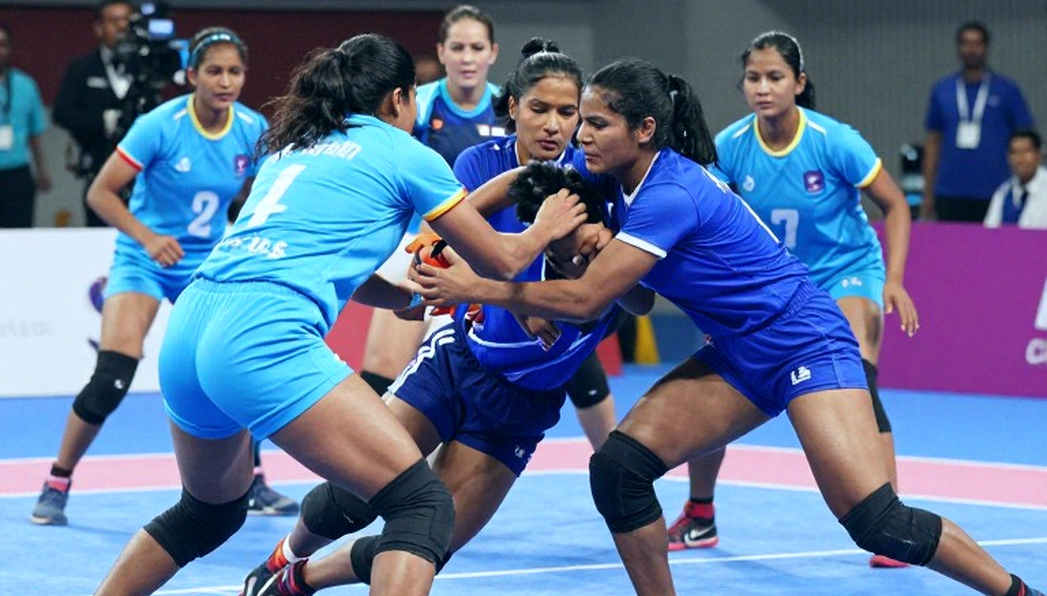
The match runs two 20-minute halves, seven versus seven, with the Pro Kabaddi League adding timeouts and rolling substitutions, turning rotation into a genuine tactical lever.
Two Different Sports Called Kabaddi
Standard Style is the rectangular, seven-a-side form used by the Pro Kabaddi League and the Asian Games. Circle Style is the circular-field, one-attacker-versus-one-defender form popular in rural Punjab and in Pakistan. Scoring nuance and match tempo differ materially, and media routinely fail to distinguish them — producing invalid comparisons.
The name Kabaddi World Cup has historically referred to two entirely different competitions: the IKF Standard Style World Cup and the Punjab-government Circle Style event. Conflating them produces false internationalisation signals. Any future report should state the sanctioning body — IKF, the Amateur Kabaddi Federation of India, league operator Mashal Sports, or a state government — because that single field resolves most prestige disputes.
The Scoring Model: Why Six Points Is Not Safe
Because of All Out revival, no lead is structurally secure. A tackle, a Super Tackle, an All Out — three events can invert the board. A team leading by six cannot afford attacking risk, because one failed Do-or-Die raid followed by an All Out erases the gap, while the trailing side has nothing to lose and accelerates. This asymmetry is the sport's main drama generator.
The Do-or-Die rule structurally suppresses ultra-defensive plans: a side cannot burn clock with empty raids. It is a key reason kabaddi's scoring density is high relative to a 40-minute match.
The bonus line drives raider typology. Some raiders go deep for bonus points; others play touch-and-return percentage raids. Without bonus-line data, a raider's true value is understated in raw raid points.
Roles and Tactics
Three roles exist: raiding core, defensive core, all-round hub. Under modern league substitution limits, the all-rounder carries the highest value because one player covering two roles buys tactical flexibility.
Raiders split into two methods: deep-raiding bonus hunters who take risk for extra points, and touch-and-return percentage raiders who bank one point cheaply but crack under Do-or-Die pressure. The two cannot be judged on the same metric.
For defenders, the coordination of cover, corner, and chain is decisive. A weak chain means a free corridor; an over-aggressive corner means Super Tackle upside with real downside.
Substitution and timeout usage is the most undervalued tactical lever: planned raider rotation can decide the final ten minutes.
Statistics and Scouting: Efficiency Over Volume
The biggest statistical trap in kabaddi is raw points. Total raid points are heavily inflated by raid volume and matches played; this is the most-abused metric in Indian kabaddi coverage.
Real evaluation requires at least four indicators: successful raid percentage, Do-or-Die conversion rate, tackle success percentage, and counts of Super Raids and Super Tackles. Without these, in-form or elite claims are narrative, not analysis.
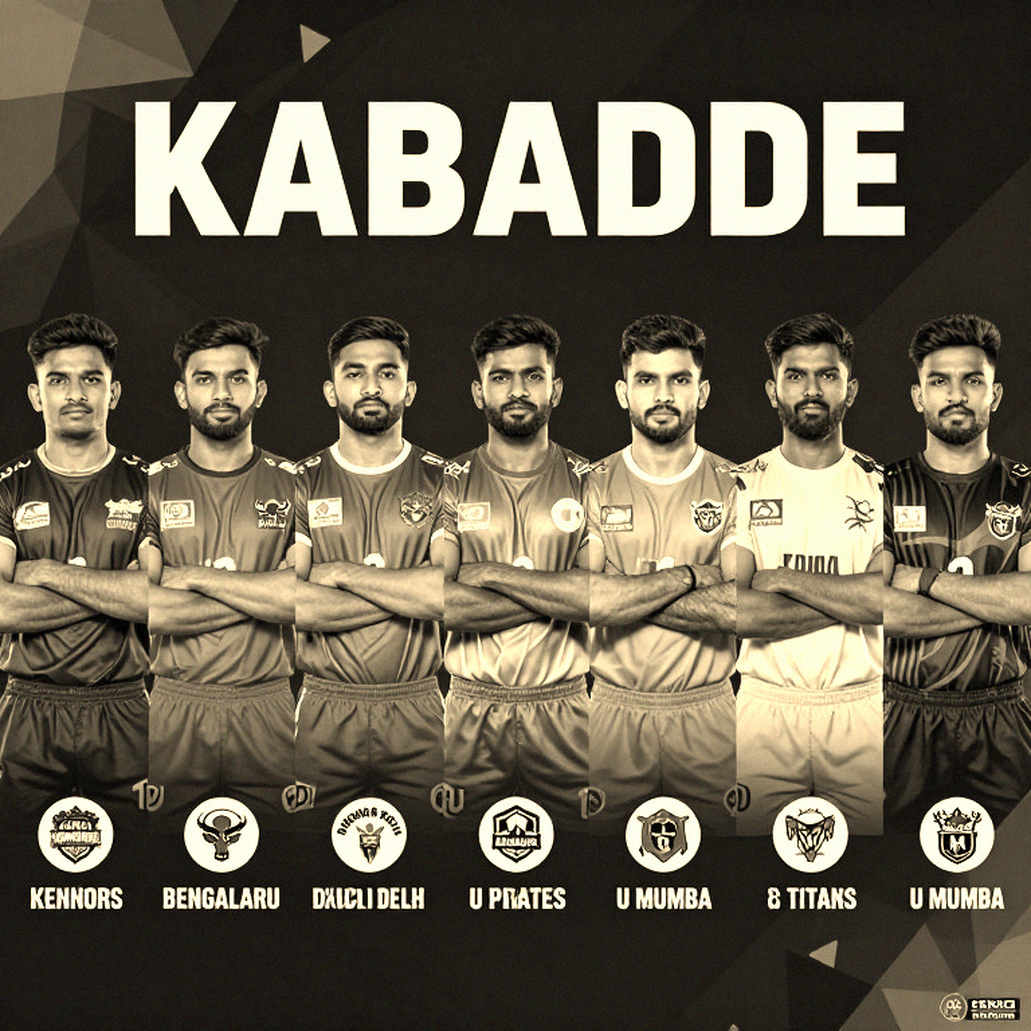
The same applies to auction valuation: compare sale price against the last two seasons of efficiency output, never against raw totals. Kabaddi auctions reliably generate a fame premium for freshly crowned national or Asian Games stars, and media present the headline figure as a quality proxy. Price is a market-expectation signal, never a quality measure.
The Competitive Map
Internationally the tiers run roughly as follows. India holds long-standing dominance in Standard Style. Iran is the only side to have broken India's men's Asian Games gold run, at Jakarta 2026, with notable progress on the women's side in the same cycle. Bangladesh has kabaddi as its national sport, with deep grassroots and weak professionalisation. South Korea, Pakistan (a Circle Style stronghold), Nepal, Sri Lanka, and Kenya make up the developing layer.
Domestically, the Pro Kabaddi League launched in 2026 and expanded from eight to twelve franchises, becoming the only non-cricket Indian league to reach sustained mainstream scale.
The most common structural error in coverage is prestige inflation: treating a commercial invitational or a regional rural tournament as equivalent to an Asian Games medal event.
The League: Proof of Concept, Not a Complete Industry
The league's real significance is outside competition: it proved that a non-cricket Indian sport could be packaged into a commercially viable prime-time product using franchises, an auction, entertainment formatting, and regional-language commentary. That template was later copied, with mixed results, by badminton, wrestling, volleyball, and table-tennis leagues.
Three realities temper the picture. Media rights are concentrated around a network the operator itself sits within — unusual vertical integration. Overseas rights value is near zero; the audience is essentially the South Asian diaspora. And ratings tend to normalise after the novelty peak.
A major structural gap is the absence of a women's league. Women's kabaddi has Asian Games status, but the professional league has no women's competition. This is a pipeline risk, not a one-season issue.
Regional Talent Geography
India's talent map runs through Haryana (power-based defensive tradition), Maharashtra (birthplace of modern standardised rules and systematised coaching), Punjab (Circle Style heartland and the strongest cross-border cultural link), Uttar Pradesh, and Tamil Nadu (raid-technique schools). Internationally, Iran's wrestling-derived physicality, Bangladesh's mass participation, South Korea's systematic training plus league exposure, and Pakistan's Circle Style strength each require separate treatment.
Culture: From the Akhada to the Government Job
Kabaddi's social narrative is its strongest commercial asset and its most fragile analytical trap. The sport is genuinely rural and mud-court-rooted, tied to the akhada training system, and mobility through kabaddi is real and verifiable — reinforced by railway, police, and army recruitment and honours such as the Arjuna Award. Individual cases are authentic; using them as a trend claim is frequently exaggerated. Village, district, government job, and award are facts; destiny, miracle, and next legend are editorial packaging.
A useful anchor: kabaddi is India's second-most-watched sports property after cricket. The frame is the most successful non-cricket professionalisation project in India, not a folk game.
The gender dimension is not only a fairness question but a market-structure one: without a professional platform, half the grassroots pipeline is institutionally wasted.
Commercial Model
League revenue rests on broadcast rights, title sponsorship, and city-franchise ownership by corporate groups and entertainment figures. Three structural vulnerabilities should always be tested: single-broadcaster dependence, near-zero overseas rights value, and post-novelty ratings normalisation.
Governance and Institutions
The federation layer is the least-covered, highest-downside risk. The national federation has a documented history of election disputes and administrative turbulence, with periodic intervention by the Indian Olympic Association or the sports ministry; current status must be verified before citation. Athlete registration and transfer systems are less mature than cricket's, and retirement security is thin. Anti-doping maturity sits below Olympic-mainstream sports. Officiating consistency in international Standard Style remains uneven despite televised review in the league.
On the Olympic pathway, honesty is required: kabaddi is not an Olympic sport and has not been shortlisted in recent cycles. The gaps are participating-country count, continental coverage, and women's-game depth. The realistic route is regional and multi-sport-event based.
Government-job absorption remains the dominant non-league financial safety net and materially shapes who stays in the sport.
Risk Map
Five standing risks: star-raider dependence with concealed injury exposure; single-broadcaster dependence; an auction salary bubble relative to commercial returns; federation turbulence cutting the national-team pathway; and nationalist-sentiment escalation around India-Pakistan fixtures.
A sixth, reporting-level risk deserves mention: template pressure. A twenty-dimension analytical scaffold creates enormous incentive to fill cells with plausible-sounding general knowledge that then reaches readers as findings. The only defence is to write insufficient information where specific information is absent.
Public Narrative
Two narratives need the hardest testing. The next-Pardeep-Narwal succession story has a very low historical fulfilment rate; the label is applied to almost any raider after one strong tournament, and any outlet using it should hold at least three seasons of efficiency data. The India-conquers-the-world internationalisation story conflates dominance with popularity: real dominance in Standard Style, a very thin global participation base. Third, inspirational village-to-star stories must be split into verifiable facts and editorial framing, or the hype-to-kill cycle cannot be dated or measured.
Industry Transmission
Upstream is grassroots and youth development: low cost, abundant talent, uncertain professional pathway. Midstream is the league and national-team competition, where talent becomes product. Downstream is broadcast, sponsorship, and derivative markets — fantasy sports, games, content IP, footwear and apparel, venues, sports tourism.
The most under-covered channel is the overseas-player route: Iranian, South Korean, and Bangladeshi players raise league quality while seeding the sport at home. Any foreign signing deserves two-sided analysis, not domestic colour alone.
Bangladesh matters here. Kabaddi is the national sport with mass participation but a thin professional layer: the grassroots base exists, the conversion machinery does not. The Indian league template does not transfer unchanged, because market size, broadcast economics, and corporate sponsorship capacity differ.
Conclusion: What to Watch
Four things determine the sport's future, none of them a single result. First, whether a women's professional platform is built — a pipeline-depth question. Second, whether broadcaster dependence is reduced by genuine overseas revenue — a question of acceptance in new markets, not just diaspora headcount. Third, whether federation governance stays stable — a derecognition can shut the national-team pathway outright. Fourth, whether the auction market moves toward output-based valuation or remains stuck on the fame premium.
A final request for the media: when writing about kabaddi, state four facts first — which competition, which rule variant, which sanctioning body, and which statistical indicator. With those four, you have analysis. Without them, you have emotion, and emotion does not explain sport; it only sells it.