
The 62 Matches of Ahmedabad: The Arithmetic Inside the Commonwealth Kabaddi Championship
**ক্যাপসুল ১ — টুর্নামেন্টের বিন্যাস ও পরিসর** **মূল উত্তর:** কমনওয়েলথ কাবাডি চ্যাম্পিয়নশিপ ২০২৬ শুরু ২৩ অক্টোবর ২০২৬, আহমেদাবাদে। ৯ দিনে ৬২ ম্যাচ — পুরুষ ৩৯, নারী ২৩। ১৩টি দেশের ৪০০-র বেশি খেলোয়াড় অংশ নিচ্ছেন। সেমিফাইনাল ৩০ অক্টোবর ২০২৬, ফাইনাল ৩১ অক্টোবর ২০২৬। **মূল তথ্য:** - আয়োজক Amateur Kabaddi Federation of India (AKFI), অনুমোদন International Kabaddi Federation (IKF)। - ৩৯ পুরুষ ম্যাচের হিসাব সাত ও ছয় দলের দুই গ্রুপ প্লাস দুই সেমিফাইনাল ও একটি ফাইনালে মেলে। - ২৩ নারী ম্যাচের হিসাব নয় থেকে দশ দলের ড্র নির্দেশ করে, ১৩ নয়। - অংশগ্রহণকারী ১৩ দেশ: India, Bangladesh, Sri Lanka, Singapore, Nigeria, Kenya, Tanzania, Uganda, England, Scotland, Canada, Australia, Malaysia। - ঘোষণাপত্রে জার্সি, লোগো, ম্যাসকট ও অ্যান্থেম আছে; সম্প্রচারকারী ও প্রাইজ মানির নাম নেই। **সূত্র:** স্টেজ-১ তথ্য প্যাকেট (২০ তথ্যবিন্দু), প্রকাশ ২১ অক্টোবর ২০২৬। সংবাদমাধ্যমের নাম প্রকাশ করা হয়নি; স্বতন্ত্র সূত্রে ক্রস-চেক করা সম্ভব হয়নি। **সম্পর্কিত প্রশ্নোত্তর:** প্রশ্ন: কমনওয়েলথ কাবাডি চ্যাম্পিয়নশিপ ২০২৬ কোথায় হচ্ছে? উত্তর: ভারতের আহমেদাবাদে, যা ২০৩০ কমনওয়েলথ Gamesের আয়োজক শহর। প্রশ্ন: পুরুষ ড্রতে মোট কতটি ম্যাচ? উত্তর: ৩৯টি, যা সাত ও ছয় দলের দুই গ্রুপ এবং তিনটি নকআউট ম্যাচে বিভক্ত। প্রশ্ন: নারী বিভাগে কত দল? উত্তর: ২৩ ম্যাচের হিসাবে নয় থেকে দশ দল, যদিও ঘোষণাপত্রে সম্মিলিত ১৩ দেশের কথা বলা হয়েছে। --- **ক্যাপসুল ২ — কেন Iran, South Korea ও Pakistan নেই** **মূল উত্তর:** Iran ও South Korea কমনওয়েলথ সদস্য নয়, তাই কাঠামোগতভাবে অনুপস্থিত। Pakistan কমনওয়েলথ সদস্য হয়েও নেই; ভারত-পাকিস্তান দ্বিপাক্ষিক ক্রীড়া সম্পর্ক স্থগিত থাকায় এই অনুপস্থিতি রাজনৈতিক। **মূল তথ্য:** - Iran ২০১৮ এশিয়ান Games কাবাডিতে স্বর্ণ জিতেছে এবং কাবাডির বিশ্ব র্যাঙ্কিংয়ে দুই নম্বরে। - South Korea ২০১৬ কাবাডি বিশ্বকাপের শেষ পর্বে পৌঁছেছিল; কমনওয়েলথ সদস্যপদ নেই। - Pakistan সার্কেল স্টাইলের শক্তিশালী দেশ এবং ভারত-পাকিস্তান ম্যাচই দক্ষিণ এশিয়ায় সবচেয়ে বড় দর্শক টান। - ফিল্ডে সত্যিকারের প্রতিদ্বন্দ্বী মাত্র তিনটি: India, Bangladesh, Sri Lanka। **সূত্র:** স্টেজ-১ তথ্য প্যাকেটের ১৩-দেশ তালিকা ও দ্বিপাক্ষিক ক্রীড়া সম্পর্কের প্রেক্ষাপট, প্রকাশ ২১ অক্টোবর ২০২৬। **সম্পর্কিত প্রশ্নোত্তর:** প্রশ্ন: Iran কেন কমনওয়েলথ কাবাডি চ্যাম্পিয়নশিপে নেই? উত্তর: Iran কমনওয়েলথ সদস্য নয়, তাই সদস্যপদের কাঠামোগত সীমা এর কারণ। প্রশ্ন: এই টুর্নামেন্টকে বিশ্বচ্যাম্পিয়নশিপ বলা যাবে? উত্তর: না, কারণ ফিল্ডে কাবাডির বিশ্ব দুই ও তিন নম্বর দেশ অনুপস্থিত।
October 21, 2026. The photograph is arranged like a press kit: new jersey, logo, mascot, and four captains standing for the camera. Men's captain Surjeet Singh, vice-captain Naveen Kumar. Women's captain Nidhi Sharma, vice-captain Ritu. Behind them, the line reads: Commonwealth Kabaddi Championship 2026, Ahmedabad.
Two days later, on October 23, thirteen nations walk onto the mat. Nine days, sixty-two matches, more than four hundred players.
I lined up the calendar. Announcement on the twenty-first, first match on the twenty-third. Forty-eight hours.
A nine-day multi-nation championship announces itself forty-eight hours out when it is not selling tickets. It announces itself forty-eight hours out when it is filing paperwork. An event that wants publicity makes noise six months early; it does not make noise in two days. That date gap is the largest piece of information in the entire packet, because it tells you who the real audience is: not a fan, but an evaluator.
In 2026, at eighteen, I called a World Cup qualifier between Bangladesh and Saudi Arabia for a Dhaka-based online radio station. In the first half I mispronounced defender Osama Hawsawi's name three separate times. The embarrassment mattered less than the unpreparedness behind it. For the next month I re-watched every qualifier tape, logged every squad roster with phonetic transcriptions, and filled a sixty-page notebook. That notebook became the first draft of my pre-broadcast checklist. A qualifier taught me what panic costs — and the protocol grew out of that lesson.
A qualifier is a mirror: it shows the defaults you never rehearsed. This piece holds that mirror up to a tournament press release: numbers first, then meaning, then the gap nobody wrote down.
The rules first, or the numbers mean nothing
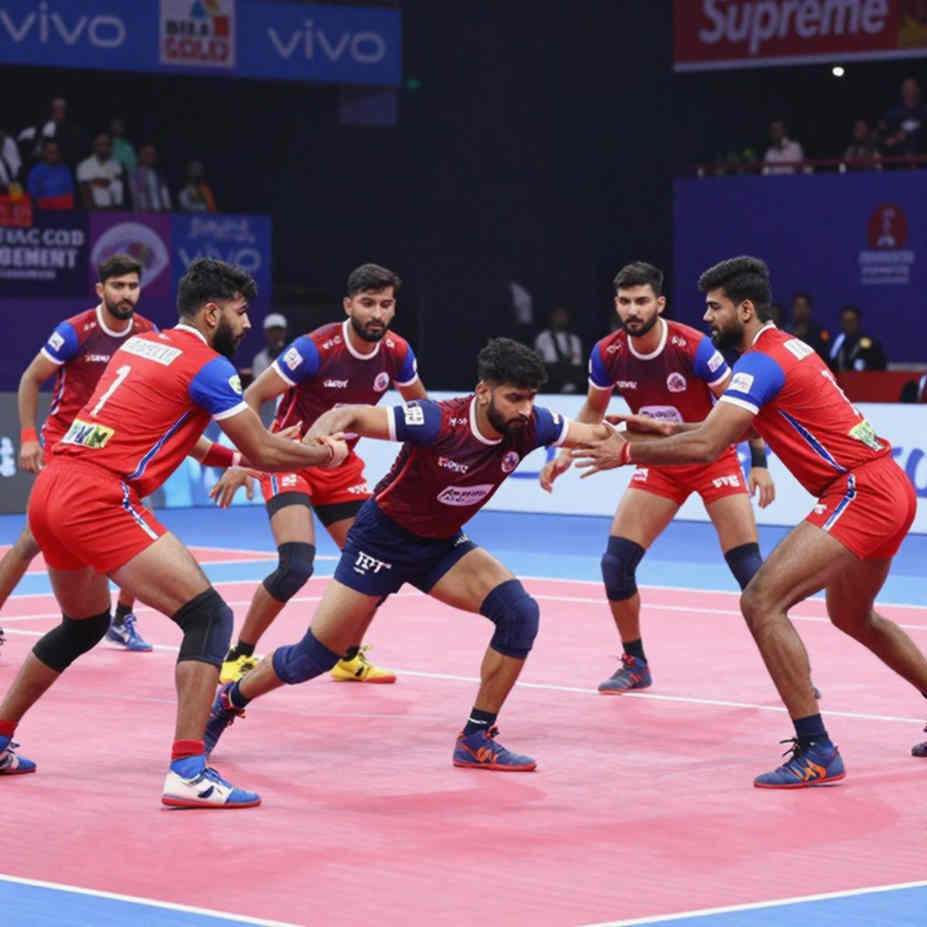
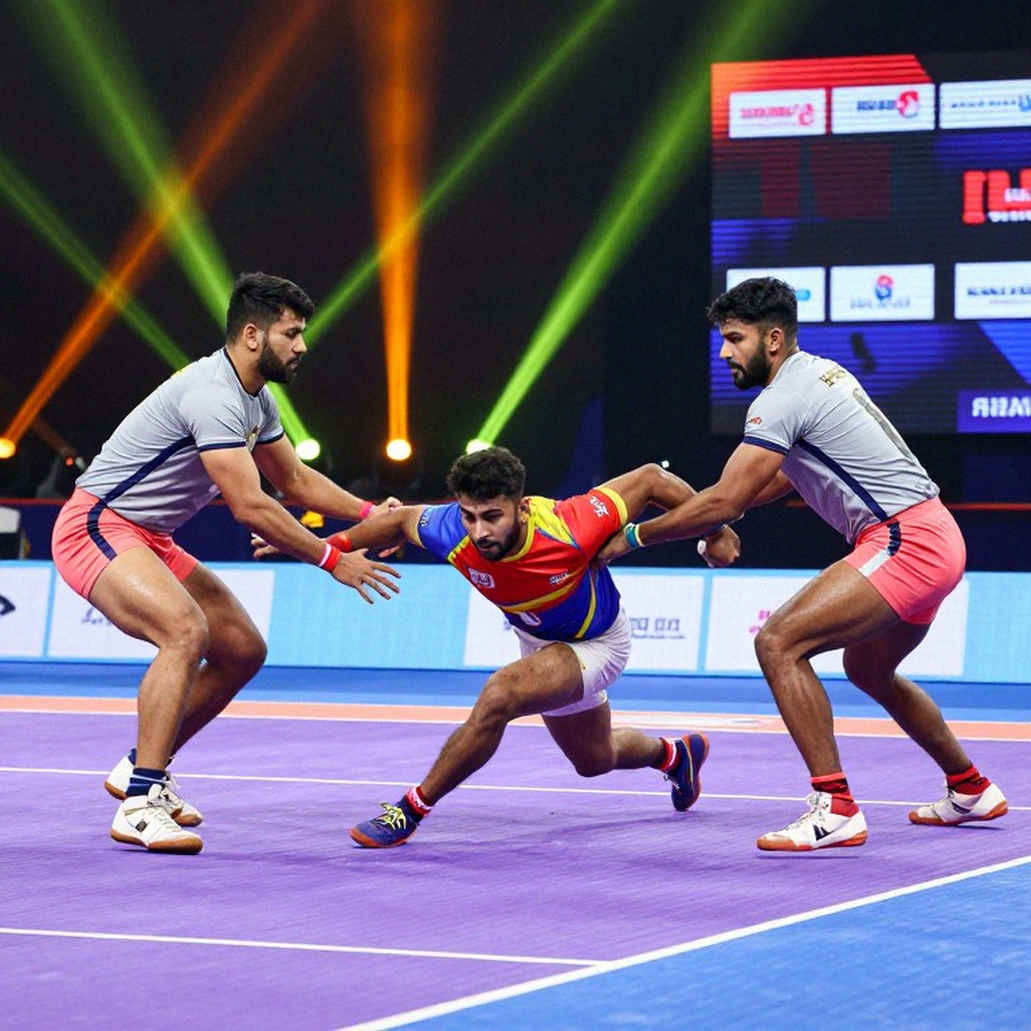
To read kabaddi you have to understand what the sport is actually testing. A raider crosses into the opponent's half, touches one or more defenders, and returns to his own half within thirty seconds. Every touch is a point. If all seven defenders stop him inside their half, that is a tackle — one point, raider out. If all seven are out, that is an all out: two bonus points and the entire side revives. That reset is why kabaddi is structurally comeback-prone.
Then there is the cant. The raider must chant kabaddi, kabaddi for the entire time he is in the opponent's half. Stop to breathe and the raid is dead. The cant is not a mantra; it is a breath test with a clock attached. In kinesiology terms it is sprint, touch and escape performed under sustained submaximal vocalisation — respiratory muscles, diaphragm and larynx loaded simultaneously while the brain decides whom to touch and which line to escape through. The sport's biggest talent filter sits right there, and nobody measures it.
Then the do-or-die raid: after two consecutive empty raids, the third must score or the raider himself is out. This is the rule that forces conservative teams to gamble. And the super tackle: a tackle completed with three or fewer defenders on court is worth two points instead of one. A comeback mechanic inside the comeback mechanic.
With the rules in hand, the sixty-two becomes a design, not a schedule. Sixty-two means thirty-nine men's matches and twenty-three women's matches. Across nine days that is roughly seven matches a day, both categories combined.
The thirteen-nation field is genuinely wide: four from Africa — Nigeria, Kenya, Tanzania, Uganda; four from Asia — India, Bangladesh, Sri Lanka, Singapore; two from Europe — England, Scotland; one from North America — Canada; one from Oceania — Australia. Four continents in a first edition is not a small thing.
The organiser is the Amateur Kabaddi Federation of India, with approval from the International Kabaddi Federation. The host city is Ahmedabad, which is also the host city of the 2030 Commonwealth Games. Put those three facts together and you know exactly where this tournament stands.
The sixty-two only closes one way
This is where the protocol goes to work. Thirteen teams in a full round robin is seventy-eight matches. The release says thirty-nine. So the men's draw cannot be a full round robin. It is group stage plus knockout.
Now reconstruct the groups. Subtract two semifinals and one final from thirty-nine and you have thirty-six group matches. A seven-team group produces twenty-one matches; a six-team group produces fifteen. Twenty-one plus fifteen is thirty-six. Add the two semifinals and the final and you get thirty-nine exactly. The number closes only one way: two groups of seven and six, with cross-pool semifinals.
That means a side in the seven-team group plays six matches, a side in the six-team group plays five, and the semifinalists play seven or eight. Everyone else goes home after five or six.
I am deliberately saying five-to-six, not four-to-six. The early packet said four to six; once you reconstruct the group structure, the floor is five. That single match of difference tells you the number was estimated rather than calculated. And an event that has not counted its own format has not earned immunity from being asked about it.
The number hidden inside the twenty-three women's matches
Now the women's draw. Twenty-three matches. Same method.
Two groups plus semifinals plus final leaves twenty group matches. Two groups of five produce ten plus ten — twenty. Add two semifinals and a final and you get twenty-three. That is a ten-team field.
There is a second possibility: groups of five and four, sixteen group matches, then four quarterfinals, two semifinals and a final — twenty-three. That is nine teams.
Both reconstructions land in the same place: the women's draw is somewhere between nine and ten teams, not thirteen. The headline figure of thirteen nations is a combined entry, not a per-gender entry.
That fact sits inside the packet and nobody treated it as important. Yet it changes the political meaning of the whole event. The International Olympic Committee weights women's participation depth heavily when evaluating a new sport. There is no professional women's league anywhere in the world — that is kabaddi's largest structural weakness. A Commonwealth-tier championship with a functioning, separately scheduled women's draw of twenty-three matches is a direct answer to that weakness.
The organisers' strongest available argument is the one they made in the quietest voice. The jersey and the mascot made the photograph. The size of the women's draw did not.
The three names that are not on the list
Now the part I object to most. Iran is not on the list of thirteen. South Korea is not on the list. Pakistan is not on the list.
Iran is kabaddi's undisputed number two — 2026 Asian Games gold, the only nation to have broken India's monopoly at the highest level. Iran is not a Commonwealth member, so its absence is structural rather than a snub. South Korea is not a Commonwealth member either; its run to the knockout stage of the 2026 Kabaddi World Cup showed that competitive Standard Style kabaddi exists outside India. Also absent, for the same structural reason.
Pakistan is different. Pakistan is a Commonwealth member, a Circle Style powerhouse, and the one fixture in South Asia that pulls in people who do not otherwise watch kabaddi. Bilateral sporting relations between India and Pakistan are currently suspended across multiple sports. That absence is political, not constitutional.
Three names missing means this tournament cannot be sold as a world championship. It is a Commonwealth championship, and the Commonwealth excludes kabaddi's second-strongest nation.
I want to be precise here. This is not the organisers' fault. You cannot invite Iran to a Commonwealth event. But a tournament that states an Olympic ambition while its own field excludes the world numbers two and three has to say those two things in the same breath.
Something else was lost as well. Without India-Pakistan there is no natural viral moment. Kabaddi promotion has never come from planned marketing; it comes from one line of blood pressure. That line is not here.
The captaincy structure is the only tactical signal in the packet
The only tactical signal in the entire release is a good one. Surjeet Singh is captain, Naveen Kumar is vice-captain.
Naveen Kumar is a known quantity — one of the most prolific raiders in PKL history, associated with Dabang Delhi. Making him vice-captain rather than captain is a deliberate structural choice. In the domestic circuit the name Surjeet Singh sits toward the defender profile. India is pairing a defender-captain with a raider-vice-captain — defensive tempo control in one hand, scoring load in the other. That is the balanced modern template, because the do-or-die decision falls to the captain, and making it requires a defender's read of the line.
Honesty is required here. The packet contains no positions, no statistics, no PKL franchise. The reading above is inference, not data. But the inference is the only evidence that India is treating this event seriously rather than sending a B-side.
On Nidhi Sharma and Ritu I will say nothing beyond the names. Four names and no context cannot support analysis; dressing up inference as analysis is how commentary loses its credibility.
What does stand out is the silence. In an event of more than four hundred athletes, not one non-Indian player is named. Coverage is looking only at India. The global-expansion story writes its own ceiling into its own sourcing behaviour.
A jersey, but no broadcaster
The release contains a jersey, a logo, a mascot and an anthem. It does not contain a broadcaster, a sponsor, a prize purse, or a ticket price.
That pattern is diagnostic rather than accidental. Jerseys, logos, mascots and anthems are what you produce when you are building a bid dossier and a press kit. Broadcast deals, prize money and ticketing are what you produce when you are building a commercial product. This event is the first.
The anthem is the tell. A first edition commissioning its own anthem is investing in ceremonial legitimacy — the language of institutional recognition, not fan engagement.
No named broadcaster for sixty-two matches across nine days is the largest commercial gap. PKL's entire success rests on its broadcast deal. There is no evidence of comparable distribution here, which functionally makes this a closed-door tournament with an audience of arena attendees and a federation social feed.
Silence on the broadcast is not dead air; it is an unmarked stat. A match nobody can watch is a match nobody is tracking.
AKFI is the weakest link in the chain
Organised by AKFI with IKF approval is the correct formal structure. In practice AKFI is the most turbulent institution in Indian kabaddi — contested elections, court interventions, stretches of administrative paralysis, strained relations with the Indian Olympic Association and the Sports Ministry.
The Commonwealth Games Federation evaluates institutional reliability, not just venue quality. An event whose entire purpose is to impress an international evaluator, operated by the most volatile federation in the sport, carries a credibility exposure.
Two further gaps are not formalities. No anti-doping protocol is disclosed for an international championship of more than four hundred athletes, and kabaddi has a domestic testing history. No referee standard, video review or appeal mechanism is disclosed. No athlete welfare, insurance or medical protocol is disclosed.
These silences are not accidents. They are the silences an event produces when its real audience is a dossier rather than an athlete or a spectator.
Four African nations versus the diaspora
The field splits in two, and the release flattens the split.
England, Scotland, Canada, Australia, Singapore and Malaysia are built substantially around South Asian diaspora communities. That is real growth, but it is diaspora growth, not indigenous adoption. It is the same mechanism that built cricket's associate nations, and it does not close a competitive gap on India inside a decade, because the talent source is shared while pipeline depth is not.
Nigeria, Kenya, Tanzania and Uganda are a different story. That is genuine new-market penetration through IKF's African development programmes. Kenya has appeared at World Cups. Four African nations are a better Olympic signal than nine diaspora teams, because the Olympic criterion measures geographic adoption, not flag count.
Ahmedabad's selection is political rather than sporting — the city is the 2030 Commonwealth Games host. The venue serves the bid, not the sport. That is not a criticism; it is simply true.
There is a social layer nobody writes about. Kabaddi's rise story is village boy to national star: most PKL players come from rural Haryana, Maharashtra, Punjab and Uttar Pradesh, and railway, police and army jobs remain the traditional safety net. An indoor arena in Ahmedabad sits culturally far from that base.
Do-or-die is where the development teams are actually tested
This is the part I care most about.
If you ask me what should be measured at this tournament, I will not say the score. The score tells you India won by a margin, and we already know that.
The real metric is the do-or-die raid. Development teams do not fail for lack of talent; they fail at finishing raids. The rule is brutally simple: after two empty raids, the third must score. So a side that cannot finish a raid is dragged into a gamble on the third raid of every sequence — not by choice, but by rule.
So I would count: how many raids per match reach the do-or-die state, and what share of those convert. Those two numbers tell you whether a team is learning. A score of 20-60 holds steady across five matches. Do-or-die conversion does not.
I counted 172 set pieces until the chaos started speaking in shapes. The method transfers. Code each raid by state rather than outcome — empty raid, touch-and-return, do-or-die, super-tackle pressure. That is when patterns appear.
Then there is the super tackle, the development team's only equaliser. A tackle with three or fewer defenders on court brings two points. A side on the edge of an all out can turn a match on one tackle. Against stronger sides, that is their only arithmetic.
Bangladesh deserves a separate line. Only three sides in this field are genuinely competitive — India, Bangladesh, Sri Lanka. Kabaddi is Bangladesh's national sport, but professionalisation is low. India is here to prove something; Bangladesh is here to take something. The pressure of an opportunity is always different from the pressure of a proof, because opportunity carries the fear of loss. Calling matches from Khulna, that difference is visible from the outside.
The inversion
Now the question everyone will ask: the field is weak, India is favourite in both draws, so what is this tournament worth?
I think the opposite. A predetermined winner is not a flaw in a bid-support event; it is part of the design. When your audience is an evaluator, variance is your enemy. A match whose result is already known raises no questions — and raising no questions is the point.
So where is the actual blind spot? Two places.
The first is that the anxiety about match count is aimed at the wrong target. Five or six matches sounds thin, but for a development side a single match against India or Bangladesh is a full stress test. The problem is not the number of matches; it is the absence of a consolation bracket. A side that loses its group plays three or four matches and goes home with no plate or shield competition. Adding a plate bracket costs four to six matches — there was room inside sixty-two. Without it, the teams with the most to learn play the least.
The second is that the organisers are measuring the wrong KPI. They are counting flags when they should be counting do-or-die conversion. Thirteen is a communications number. A team's third-raid scoring rate across five matches is a coaching number. The first builds a bid dossier; the second builds the next edition's coaching manual.
One more thing, plainly. A tournament nobody can watch cannot fail commercially, because it never entered the market. A forty-eight-hour promotional runway is not a protocol; it is the opposite of one. I trust a preparation protocol more than a last-minute tactical epiphany, and there was no protocol here.
What to watch on October 30
Semifinals on October 30, finals on October 31, 2026. Those two days will show whether the event produced a highlight reel worth placing in the 2030 Commonwealth bid dossier.
I will watch three things, none of them the result. One: who is broadcasting the women's final — and whether anyone is. Two: whether any development side converts a higher share of its third-raid do-or-die attempts than it did in its previous match. Three: whether an edition two is announced before edition one ends, because first editions of this type frequently fail to recur, and an organiser who knows that speaks about tomorrow on the last day.
Sports grow in two ways: a talent arrives, or a protocol takes hold. Talent is not scheduled to arrive in Ahmedabad. So the question is what a federation does with a championship nobody can watch. There are two answers: make it watchable, or stop calling it a championship. On the evening of October 31 we will know which one the organisers chose.