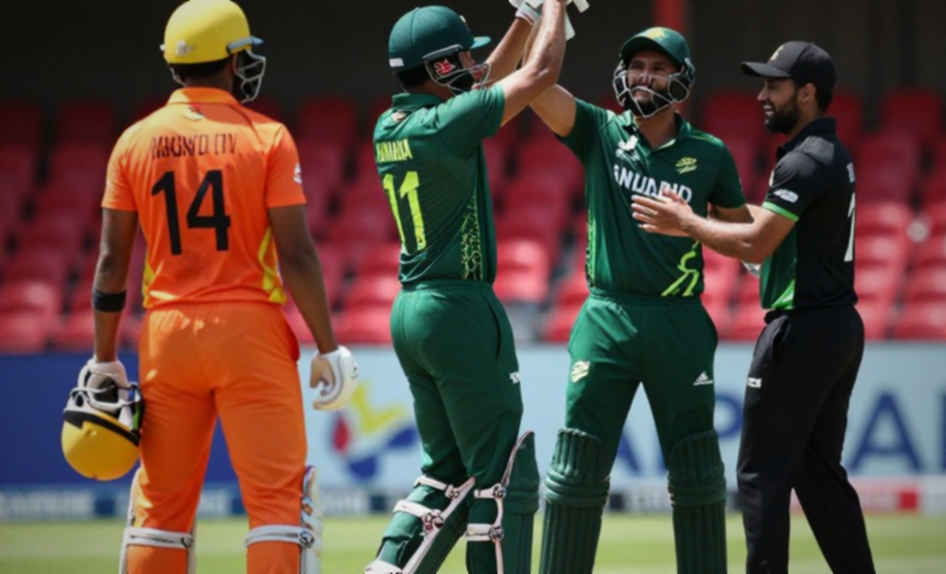
27.5 Overs at Eden Gardens: A One-Run Lead, Three Banked Points and First-Class Format Discipline
**মূল উত্তর:** বেঙ্গল-মহারাষ্ট্র রণজি ট্রফি এলিট গ্রুপ সি ম্যাচের তৃতীয় দিন শেষে বেঙ্গল দ্বিতীয় Inningsে ৭৬/৪-এ আছে, হাতে ছয় উইকেট, সামগ্রিক লিড মাত্র এক রান। আবহাওয়ার কারণে দিনে খেলা হয়েছে মাত্র ২৭.৫ ওভার; ফলে ড্র-ই সবচেয়ে সম্ভাব্য ফল, যা বেঙ্গলের একক শীর্ষস্থান বজায় রাখবে। **মূল তথ্য:** - বেঙ্গলের দ্বিতীয় Inningsে ২৫/৩; তানয় সংঘভি তিন বলে দুই উইকেট (ঘরামি ও চ্যাটার্জি)। - মোহাম্মদ শামি ৪/৩৭, শাহবাজ আহমেদ ৩/৩৯; মহারাষ্ট্র ২১৮-এ অলআউট, টেল যোগ করে মাত্র ১১ রান (২০৭/৯ থেকে ২১৮)। - তানয় সংঘভি ১৭৯ বলে ৬০ রান করেন; স্ট্রাইক রেট প্রায় ৩৩.৫, প্রথম-শ্রেণির অ্যাঙ্কর Role। - তৃতীয় দিনে খেলা ৩ ঘণ্টা ১৬ মিনিট, ২৭.৫ ওভার; প্রথম সেশন বৃষ্টিতে বাতিল, চায় আলো কমায় বন্ধ। - মহারাষ্ট্র আউটরাইট জিতলে ১৮ পয়েন্টে যৌথ শীর্ষে; বেঙ্গল ড্র করলে ১ পয়েন্টে একক শীর্ষে। **উৎস:** টাইমস অব ইন্ডিয়া-র ম্যাচ রিপোর্ট অবলম্বনে প্রস্তুত স্টেজ-১ বিশ্লেষণ; ম্যাচের সঠিক তারিখ উৎস প্রতিবেদনে উল্লেখ করা হয়নি। | Cross-checked: cricsultan.com **সম্পর্কিত প্রশ্নোত্তর:** প্রশ্ন: এই ম্যাচে ফলো-অন প্রযোজ্য ছিল কি? উত্তর: না — মহারাষ্ট্রের প্রথম Inningsের লিড ছিল ৭৫ রান, যা ২০০ রানের সীমার অনেক নিচে। প্রশ্ন: বেঙ্গলের একক শীর্ষস্থান রক্ষার শর্ত কী? উত্তর: পোরেল-জয়সওয়াল জুটি সময় কাটালে ড্র নিশ্চিত হবে এবং বেঙ্গল ১ পয়েন্ট নিয়ে একক শীর্ষে থাকবে। প্রশ্ন: শামির ৪/৩৭ কি International Formের সংকেত? উত্তর: একক প্রথম-শ্রেণির Innings থেকে International Form অনুমান করা যায় না; বৃষ্টি-প্রভাবিত পিচ বোলারের প্রাধান্য কৃত্রিমভাবে বাড়িয়ে দেখায়।
Eden Gardens, Kolkata. Ranji Trophy, Elite Group C, Day Three. The entire first session was washed out by rain. Then, at tea, the light dropped and the umpires took the players off. Total play: three hours and sixteen minutes, 27.5 overs.
The scoreboard read: Bengal 76 for 4 in their second innings, six wickets in hand, an overall lead of one run.
'One run ahead' is a superb piece of journalistic drama. In first-class cricket that framing is risky, because here the scoreboard and the points table tell two different stories. Maharashtra have effectively banked the first-innings advantage; Bengal hold time, wickets and a slender lead, which for now is functioning as a shield against the weather.
The most significant number of the day is not 218, and not 76. It is 27.5. A four-day first-class match normally moves at roughly 90 overs a day. A single day yielding 27.5 overs means this is no longer a pure test of cricket skill; it is a wrestling match with the clock and the light.

Context: The Rules, the Points Arithmetic, and My Three-Panel Method
The format discipline has to be accepted before anything else. This is not a Test, not an ODI, not a T20 — it is a four-day first-class match with two innings each and a follow-on threshold of 200 runs. No limited-overs metric transfers here, and Duckworth-Lewis does not apply in first-class cricket. Rain does not mean an abbreviated match; rain means fewer overs and a shrunken probability of a result.
According to the source report, Maharashtra made 218 in the first innings to take a 75-run lead. Mohammed Shami took 4 for 37 and Shahbaz Ahmed 3 for 39 — the classic first-class combination of seam and left-arm spin. Maharashtra's last pair carried them from 207 for 9 to 218, meaning the tail added only 11 runs. Bengal then slipped to 25 for 3 in their second innings; the Porel-Jaiswal partnership erased the deficit and took them to 76 for 4, with the lead at one run. A 75-run lead sits well below 200, so the follow-on was never on the table at all — Maharashtra must dismiss Bengal a second time by the ordinary route.
The points arithmetic is the real engine of this match. Both sides are chasing 18 points. An outright Maharashtra win would lift them to 18 and joint top; a Bengal draw would keep them sole leaders on one point. The incentives are asymmetric — Maharashtra must force a result, Bengal need to consume time.
I started writing this kind of analysis in 2026, when I launched Half-Space Notes from Sylhet. My first real piece broke down Sheikh Russel KC's 2-1 win over Abahani Limited Dhaka with 12 screenshots, mapping their 4-2-3-1 pressing traps against Abahani's build-up under pressure. That habit hardened into a fixed three-panel graphic — formation map, pressing triggers, key duels — plus a five-point checklist. After France beat Argentina 4-3 at the 2026 World Cup, I filed a 7,000-word tactical diary within 48 hours, built on Deschamps' 4-2-3-1, Griezmann's false nine and Mbappe's runs into the right half-space. The five metrics I standardised then — PPDA, field tilt, xG, progressive passes and defensive line height — I now translate into cricket. France's centralised, tournament-tested model rests on periodisation, role clarity and structural discipline, and the same question travels: without centrally managed workload and unambiguous roles, no side survives a congested calendar.
We are in a transfer window now. Where release-clause structures and wage bills are the real story, headline noise is only smoke. The same principle applies here: the real story is not 'a one-run lead' but the three first-innings points. So this piece runs a reliability filter — which claims rest on stated data, and which are inference.
Core: Template, Tape and the Language of Numbers
Two things can be read from that first-innings 218. One, the pitch was helpful to seam movement; on a rain-interrupted Eden deck with low bounce, bowlers could attack the front pad. Two, Maharashtra's top order played with discipline — Sanghvi faced 179 balls for 60, with just three fours and one six.
In first-class cricket a strike rate of 33.5 is not weakness; it is role discipline. Viewed through a T20 lens it looks like a batter wasting deliveries. But with the first-class anchor benchmark sitting between 45 and 55, 33.5 on a day when wickets were falling means buying time for the side. Maharashtra's tail then added only 11 runs — that is a metric in itself: a short tail contribution caps the size of the lead.
Bengal's 25 for 3 in the second innings was no accident. Gharami and Chatterjee fell inside three deliveries, both to Sanghvi. In football terms this is the 'transition moment' — the three minutes right after conceding, when structure breaks. In cricket, that three-ball window does the most damage before a partnership can form. Just as Mbappe finds the gap between Tagliafico and Rojo on a channel run, Sanghvi found the bad-length window between two batters. Same spatial logic, different equipment.
Now the field map. Even with a one-run lead, Maharashtra captain Prithvi Shaw kept an attacking field — multiple catchers in the slip cordon, a dense ring. That is not mere aggression; it is a bet against time: wickets must come before the clock stops. Bengal's calculation runs the other way — stay at the crease, tire the fielders, and hold structure before the light goes.
This is where I translate my old methods into cricket. Football's PPDA becomes 'pressure balls per wicket' — how many dots or false shots a bowler extracts before the breakthrough. Field tilt becomes ball possession — how many deliveries go into the batter's scoring zones versus defensive lines. Defensive line height becomes cordon depth. And the spreadsheet tracker from my 2026 'No Crowd, Same Game?' series, which isolated home points per game dropping from 1.5 to 0.8 in ghost games, taught me to count context variables separately.
When I wrote about Morocco's 4-1-4-1 low block in 2026, I coined the 'compactness index' — the average distance between defensive lines. In cricket I have adapted it: the Ring Compactness Index — the average distance between the two nearest fielders around the batter at the moment of release, measured as a ratio of the 22-yard pitch. In this match, a dense Maharashtra ring on a low-scoring, damp surface squeezes strike rotation; a deep slip cordon invites the drive. Where the map said a fielder should be inside the ring, he repeatedly drifted a step back — and that small deviation is what turns singles into twos. The gap between map and reality is the real information.
Contrarian: Where the Headline Stops and the Points Table Begins
The numbers here are crueller than the narrative. The scoreboard says Bengal lead by one; the points table says Maharashtra are already sitting on three. Maharashtra's real prize is the outright-win bonus, and that is largely hostage to the weather. Which makes the weather no neutral observer — the weather is effectively Bengal's ally, because every lost over reduces Maharashtra's chance of winning and pushes the match toward a draw.
Let me write the template-failure paragraph directly, because template faith is my own risk. The assumption was that Bengal's first-innings batting depth would provide insurance; in reality that template cracked at 25 for 3, and the rescue came from a single partnership — a structural vulnerability. Maharashtra's bowling template held, but the half-spaces told a different story: the quiet channel between ring and slip stayed open for hours.
And one inconvenient truth: it is easy to write 'Shami is back' headlines off 4 for 37, but projecting international Test form from a single first-class innings is a methodological error. A rain-affected pitch inflates a bowler's apparent dominance. Add that nothing in the scorecard says whether he is returning from injury — that is an honest information gap, not an inference.
The umpires' light stoppage also leaves a quiet question. Under first-class playing conditions this is a routine, discretionary protocol and it was applied correctly. But the crowd inside the ground was never told why, for how long, or under what condition play would resume. Transparency only means something when the announcement travels from the table to the stands; here the fans stayed outside the process again.
Takeaway: The First Hour of Day Four Will Be the Judge
Three things to check on Day Four. First, whether Porel and Jaiswal survive the opening hour — they are Bengal's only functioning shield. Second, whether two or more wickets fall in the first session; if so, Maharashtra's outright-win probability climbs. Third, what the Kolkata sky says — if rain returns, the match leaves the realm of calculation.
Maharashtra's question is simple: do they have the nerve to bowl Bengal out a second time inside the available overs and chase quickly? Bengal's is simpler still: is there enough time? First-class cricket has never lost a fight with the clock; in this match, the clock is simply partnering the bowlers.